Get Full Government Meeting Transcripts, Videos, & Alerts Forever!
Get email alerts on the Budget Fy26 topic
No spam. Unsubscribe anytime.
MNPS presents FY26 budget proposal centered on pay, continuity and ESSER-funded programs
Summary
Metropolitan Nashville Public Schools administrators presented a proposed FY26 operating budget that prioritizes continuity of operations, strategic employee compensation, safety and ESSER-funded student supports while noting state and federal revenue uncertainties and proposed savings to meet a mayoral allocation.
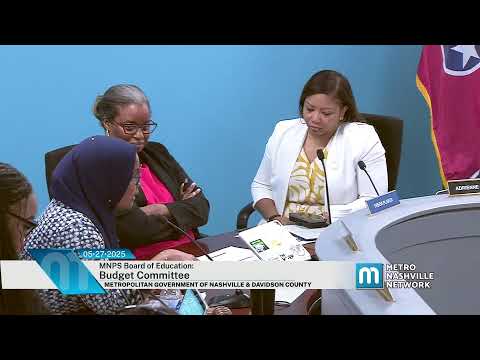
Metropolitan Nashville Public Schools officials presented a proposed FY26 operating budget that centers on sustaining recent academic gains and preserving school-level services while addressing inflation, benefits cost increases and state/federal funding uncertainty. Dr. Battle, who led the presentation for MNPS, told the finance committee the proposal pairs continuity-of-operations funding with targeted ESSER investments and personnel compensation adjustments.
“We are celebrating really historic progress,” Dr. Battle said, summarizing recent gains and framing the proposed budget as a means “to sustain the growth and the achievements” the district has recorded.
The proposal organizes investments under four board-adopted priorities: continuity of operations; continuing strategic investments (including ESSER-to-operating transitions); strategic employee compensation; and comprehensive safety and security planning. Chief Robles outlined the revenue assumptions and line items that translate those priorities into dollar figures and constraints, and he stressed uncertainty from state and federal changes that could affect district revenue.
Chief Robles said the district is building the proposed budget to align with an allocation placed in the mayor’s ordinance and flagged three revenue risks: recent state voucher and charter legislation, potential changes to the fiscal-capacity factor under TISA, and federal grant/reimbursement uncertainty. “We are grateful that the mayor’s proposed budget... is the most significant investment that we’ve seen in education in the recent years, with a 13% increase,” Chief Robles said, while noting some federal reimbursements tied to ESSER remain unresolved.
On compensation, MNPS proposes multiple components: step increases identified largely as continuity-of-operations items and a district-wide cost-of-living adjustment. The administration presented the compensation package as nearly $45 million in employee-related investments that include $9.6 million for salary step increases and a 3% COLA estimated at $19.2 million. The district also proposed a $2,000 bonus for certificated staff; officials said the combined effect for certificated staff will average roughly a 5–6% increase when the bonus and COLA are included.
The presentation included line-item highlights: $4.6 million to fund textbook adoptions from the operating budget, $1.2 million for additional high-school safety measures, an estimated $13.5 million to reflect pass-through charter funding tied to revenue growth, $20.4 million for school-based student supports, and roughly $21.4 million for inflationary contractual increases. Officials said the administration expects to deploy approximately $65–66 million of ESSER-derived investments for mental health, expanded tutoring and college-and-career-readiness supports.
To meet the allocation in the mayor’s proposed ordinance (presented at the meeting as roughly $132 million in net new resources), the administration said it will pursue targeted savings and manage hiring timelines. “We are taking a couple of actions to meet our allocation, which 1 is $21,000,000 in targeted savings,” Chief Robles said, citing program deprioritization and short-term savings from open positions as two levers the district will use. Officials emphasized they are not cutting school-allocated positions; rather, the administration described actively managing vacancies and reprioritizing non-school expansions.
Board members pressed for details and potential trade-offs. Board member Block asked how school-based budgeting ties to the proposal; Dr. Battle explained schools are funded primarily through the SBB process and that a school’s allocation is driven by enrollment and student-need weightings, including the board’s adjustment to base weights under TISA. Board member Block and others also asked about the insurance trust: MNPS officials and Chief Robles said health-care costs are projected to rise about 9% next year and that the board historically has covered the bulk of premium increases (the employer share, described in the meeting as roughly 75%). Officials said the district has absorbed roughly $30 million in past trust shortfalls and is proposing employer-side contributions to rebuild reserves rather than passing the full cost to employees.
On employee out-of-pocket impacts, MNPS provided a range for employee premium increases. The administration said employees would see a premium increase in the approximate range of $16 to $38 per pay period, depending on coverage tier, and noted those amounts are smaller than the presented average compensation increases for most certificated staff under the proposed COLA and bonus.
Board members also requested more detail about large program buckets that could be considered for reductions if the board sought a higher COLA (for example, moving from 3% to 4% or 5%). Chief Chieng and other staff summarized what falls under the district’s college-and-career-readiness (CCR) line—ACT/preACT supports, work-based learning infrastructure, early postsecondary options (AP/IB/dual credit) and related fees and exam costs that MNPS currently pays centrally rather than passing to students. Board members asked for a clear inventory of “aspirational” investments and ESSER-funded items (the presentation listed items such as early learning centers, performing-arts investments, student success centers, safety ambassadors and weekend enrichment) to assess potential trade-offs.
Several board members urged the group to bring fully developed alternative proposals if they want to pursue different trade-offs. “If there’s a proposal that is different than what is being proposed by the administration, [... ] here's what we would change. Here’s how it would impact students,” one member said; the board requested evidence on how alternative allocations would affect hiring, vacancy rates and student outcomes.
Next steps from the meeting: MNPS said it will continue to refine revenue estimates as state and federal clarity arrives, finalize hiring and position management assumptions, and provide the board with the requested breakouts of aspirational and ESSER-funded items so members can model trade-offs. The board encouraged staff to return specific impact analyses for any suggested changes so the board can weigh employee compensation against programmatic investments and student impacts before adopting a final FY26 budget.
Community members and staff can expect further budget briefings as MNPS finalizes the booklets and responds to the outstanding state and federal variables identified in the presentation.