Get Full Government Meeting Transcripts, Videos, & Alerts Forever!
Get email alerts on the Semi Independent Agency Review topic
No spam. Unsubscribe anytime.
Legislative fiscal office: semi‑independent agencies largely within budgets; committee moves report to full Ways and Means
Summary
The Joint Committee on Ways and Means Subcommittee on General Government on May 27 acknowledged receipt of a Legislative Fiscal Office review of semi‑independent agencies and voted to send the report to the full committee.
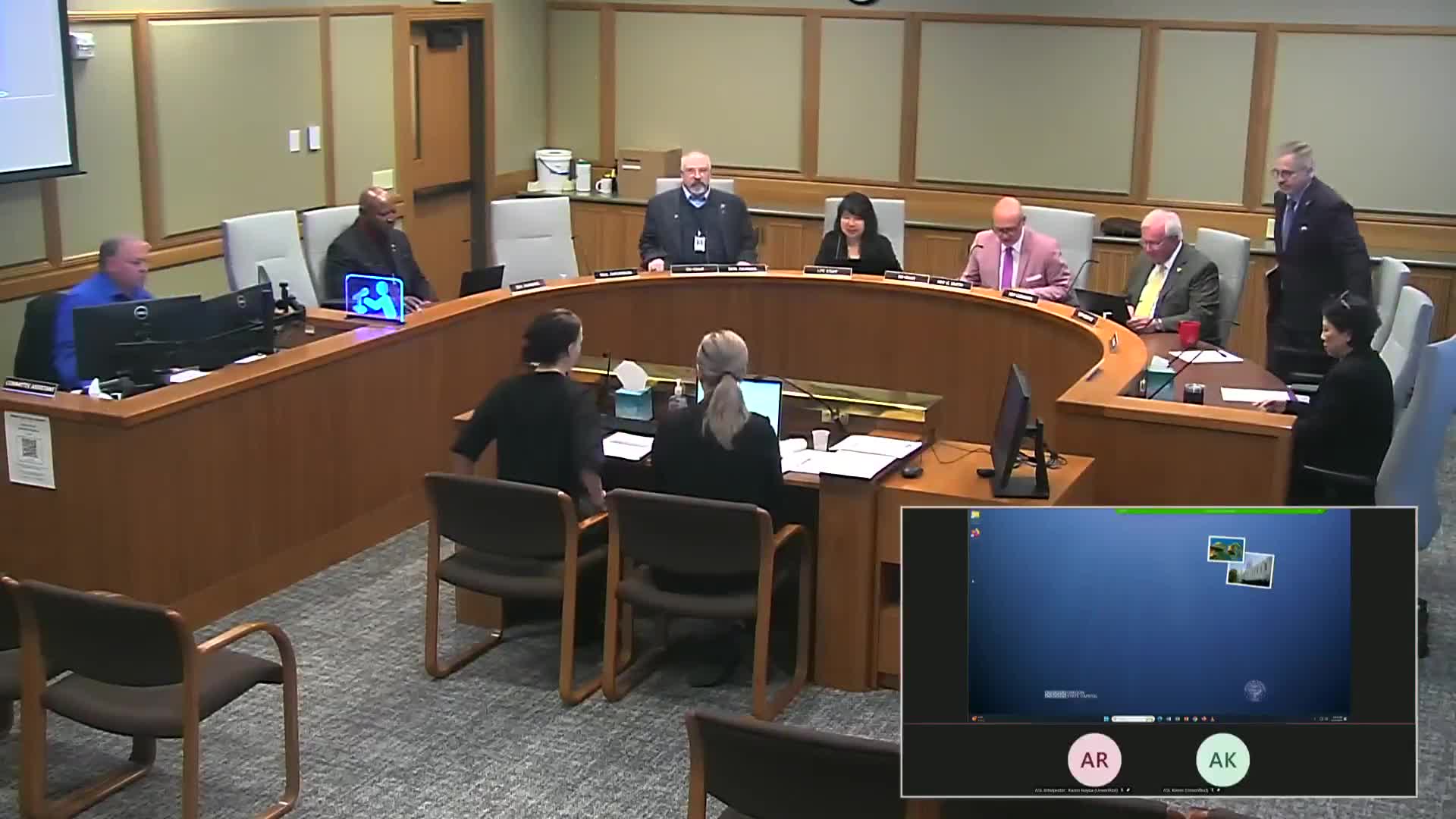
The Joint Committee on Ways and Means Subcommittee on General Government on May 27 acknowledged receipt of a Legislative Fiscal Office review of Oregon’s semi‑independent agencies and voted to send the LFO report to the full committee with the LFO recommendation.
The Legislative Fiscal Office review, presented by Haley Morris Miller, Legislative Fiscal Office analyst, and Emily Coates, Legislative Fiscal Office analyst, covered 11 semi‑independent agencies that are statutorily required to submit biennial reports and summarized agency budgets, licensing and enforcement activities, and financial reviews for the 2021–23 biennium.
“LFO reviewed each submitted report that summarizes the agency’s performance for the 21–23 biennium for completeness and compliance with statutory requirements,” Coates said. She added that the review is not an audit and that findings are limited to information agencies provided.
Why it matters: semi‑independent agencies set many licensing fees and operate largely outside the executive branch budget process. The LFO flagged that most of the covered agencies are self‑funded through fees, federal funds, grants and program revenues, and that their budgets are not reviewed through the executive branch or the Joint Committee on Ways and Means the same way standard state agency budgets are handled.
Key findings and figures: LFO reported that 11 agencies submitted a Moss Adams financial review covering the biennium ending June 30, 2023, and that the agreed‑upon procedures generally found adequate controls with recommended improvements. LFO found that, overall, agencies operated within their 2021–23 budgets and provided explanations for variances.
Selected agency highlights given in the presentation included: the Board of Architect Examiners (about $1.5 million in 2021–23 expenditures, roughly $1.6 million adopted for 2023–25); the Appraiser Certification and Licensure Board (about $2.5 million actual, $2.7 million adopted); the Board of Examiners for Engineering and Land Surveying (about $4.2 million actual, $4.7 million adopted); the Landscape Contractors Board (about $1.8 million actual, $2.3 million adopted); the Oregon Patient Safety Commission (about $3.1 million actual, $4.0 million adopted for 2023–25, 11 positions); and the Oregon Wine Board (about $4.9 million actual, $5.8 million adopted). The LFO materials include appendix tables showing ending fund balances and budget‑to‑actual comparisons.
Legislators pressed on oversight, transparency and specific programs. Representative Smith (Co‑chair) asked whether LFO tracks agencies’ ending fund balances and whether agencies are subject to public records requests; Haley Morris Miller said LFO does track ending balances and that agencies are subject to public records requests. Representative Smith also asked whether LFO collects cash‑flow statements; Miller said LFO does not collect month‑by‑month cash‑flow statements but asks about timing of fee collections.
On oversight authority, Representative Peter Gomberg asked what the Legislature can do if a semi‑independent agency takes actions the Legislature opposes. Coates said the Legislature can revoke an agency’s semi‑independent status and return it to direct legislative or executive oversight, but she did not list other specific enforcement tools off the cuff.
The report noted several entities that submit different reports or appear under separate statutory requirements: the Oregon Tourism Commission (Travel Oregon), the Travel Information Council, and the Oregon Film and Video Office. LFO cited ORS 284.126 regarding the tourism commission’s filing requirements; that statute requires the commission to file adopted budgets and financial statements with LFO and to report annually on transient lodging tax receipts and grant awards. LFO said Travel Oregon’s budget for 2021–23 was reported as about $91.8 million and the 2023–25 budget about $95.4 million.
Representatives and agency officials also answered questions about particular policy areas. Sally Crawford, chief financial officer for the Oregon Wine Board, explained that the privilege tax referenced in board materials applies to sales made in Oregon and that the grape assessment is based on tons crushed; she said the privilege tax rate has not changed in roughly 40 years and that wineries that sell more than 40,000 gallons in Oregon are subject to the privilege tax. Todd Davidson and Kate Maumgartner of Travel Oregon discussed the commission’s use of transient lodging tax to fund statewide tourism programs, regional cooperative programs and competitive grants.
On patient safety, Valerie Harmon, executive director of the Oregon Patient Safety Commission, told the committee that the commission operates two statutorily established voluntary programs: a confidential patient safety reporting program and an early discussion and resolution program. “The patient safety reporting program is a voluntary program,” Harmon said. She emphasized the commission is non‑regulatory, receives voluntarily submitted data that is protected by state law to allow learning and de‑identified sharing for quality improvement, and does not provide regulatory oversight of facilities such as prisons, foster‑care settings or other community‑based long‑term care settings.
Legislators raised the nonoperational status of the Citizens’ Initiative Review Commission; LFO staff said the commission has been nonoperational since the 2015–17 biennium because it has not received appropriations and historically relied on donations. Committee members asked whether a bill would be needed to remove the entity from state accounts; LFO staff said they did not have an answer on fundraising or removal and would follow up.
Committee action: Kim (committee staff) relayed the LFO recommendation that the subcommittee acknowledge receipt of the LFO report. A member moved that the subcommittee acknowledge receipt and forward the report to the full committee with the LFO recommendation; the motion carried without recorded opposition and Senator Anderson agreed to carry the report to the full committee.
The LFO told the committee it will request additional information in the next reporting cycle (reports due April 2026), including expanded consumer protection details, time‑to‑resolution metrics for investigations and results from a board best‑practices survey.
Subcommittee members closed the work session and noted upcoming budget and policy items scheduled for the next day.