Get Full Government Meeting Transcripts, Videos, & Alerts Forever!
Get email alerts on the Juvenile Detention Financials topic
No spam. Unsubscribe anytime.
Cowlitz County finance staff flag overtime, vacancies in juvenile detention budget; 3-month follow-up ordered
Summary
Finance staff told commissioners juvenile detention’s overtime is above last year’s four-month level and that coding and time-sheet issues, vacancies and training-related overtime are driving costs; county will run a three-month review and provide time-sheet training.
Cowlitz County finance staff on Monday told the Board of Commissioners that juvenile detention is drawing significant overtime and that coding and staffing issues are contributing to higher-than-expected costs.
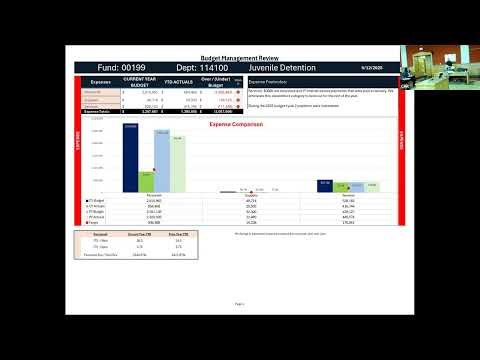
Finance Director Kathy Funk Baxter said juvenile detention is supported primarily by the general fund and that the department’s overtime for the first four months of this year is $129,006.47, compared with $103,231 for the same period last year. “We typically amend revenue budgets in the third quarter,” she said, adding staff plan to amend juvenile revenue lines at that time.
Mike Schultz, juvenile detention manager, said much of the overtime ties to vacant lead positions and to training. “All of our about half of my part time staff work for other parts of the county, so almost all of their pay comes out of my overtime budget,” Schultz said. He said the facility began the year with five open positions and that promotions and backfills delayed the expected reduction in overtime until April–May, when new hires finished training.
The finance presentation showed the detention personnel budget at $2,810,965 with actual payroll through April of $854,004.68. County staff reported 3.75 open positions in the detention staffing roster and noted some time cards appear to be miscoded; the finance team recommended targeted time-sheet training and further review.
Schultz described operational reasons for overtime spikes, including simultaneous training periods and an event that required opening a third housing pod for safety and separation of co-defendant juveniles. He said the facility’s bed capacity is roughly in the 70-bed range but that normal staffing is set to cover two pods — about 32–36 youths when pods are full — and that staffing needs do not scale down if population is low: “Because whether we have 2 kids or whether we have 36 kids, we still have to staff that the same.”
Schultz also described the in‑house training load for new hires (about 200 hours) and said some overtime coding for training has been applied to the overtime line rather than training budgets, which inflated the overtime account. Finance staff said they found sample time cards with irregularities that could mean both underpayments and overpayments and recommended a focused payroll coding review.
Commissioners and staff agreed to return with updated financials in three months to monitor trends. Funk Baxter said she would schedule a three-month review of juvenile detention and probation financials.
The finance briefing also reviewed juvenile probation revenue, noting intergovernmental (state BECCA-related) and behavioral health tax transfers as primary revenue sources and personnel budgets for probation at about $1,637,000 with current payrolls running below the seasonal target. No formal votes were taken during the financial review.