Get Full Government Meeting Transcripts, Videos, & Alerts Forever!
Get email alerts on the Tax Litigation Class Actions topic
No spam. Unsubscribe anytime.
Committee backs bill to bar class actions in tax appeals, department says individual appeals preserve taxpayer protections
Summary
The Department of Revenue told the Senate committee that class‑action procedures do not suit tax appeals and that existing refund-claim and appeal processes better protect individual taxpayers; the committee reported the bill favorably without objection.
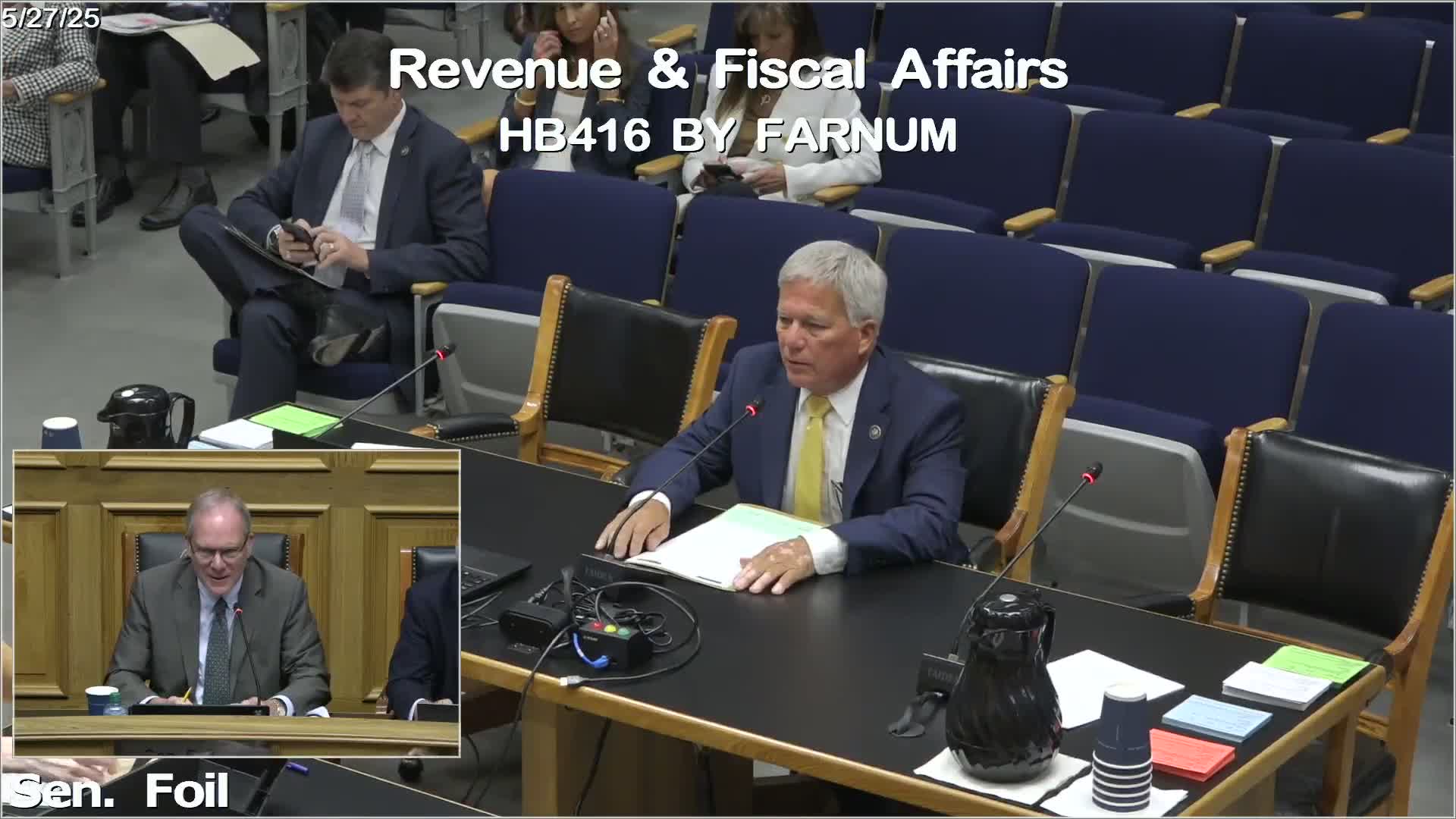
The Senate Committee on Revenue and Fiscal Affairs reported House Bill 416 favorably on May 27, 2025, after hearing testimony from Department of Revenue officials who said class‑action lawsuits are an ill fit for state tax appeals.
Representative Farnham introduced the bill and Luke Morris of the Department of Revenue told the committee that tax disputes are highly individualized and that the department prefers existing refund-claim and administrative appeal processes. “We would propose to keep the process we have in place where we can treat each taxpayer fairly and based on their own separate tax position instead of having to litigate this on a class action scale,” Morris said.
Why it matters: Committee members expressed concern that certificates of class membership can mislead taxpayers into thinking they are protected by a class action that may never be certified. Brandy Averett of the Department of Revenue added that courts historically have not certified tax classes because members do not meet class-certification requirements; when proposed tax classes have been dismissed, members who relied on the class sometimes lost individual remedies.
Key details: Morris and Averett described a recent Board of Tax Appeals ruling that declined to certify a class and noted prior examples — such as a group of more than 700 taxpayers in an alternative‑fuel case — where the department handled multiple individual appeals by grouping them administratively, with the department engaging a single expert, rather than by class litigation. Senators said they were mindful of access-to-justice concerns but concluded the class-action procedure is not an appropriate vehicle for typical tax disputes.
Outcome: Senator Morris moved to report HB416 favorably; the motion carried with no objections. The committee did not amend the bill at the hearing.
Ending: The committee’s action preserves the legislature’s existing statutory refund and appeal mechanisms as the preferred route for resolving tax disputes, while leaving other legal remedies outside the scope of this bill.