Get Full Government Meeting Transcripts, Videos, & Alerts Forever!
Get email alerts on the Capital Outlay Hb2 topic
No spam. Unsubscribe anytime.
Senate revenue committee hears Division of Administration overview of HB2 capital outlay, warns cash constraints could stall local projects
Summary
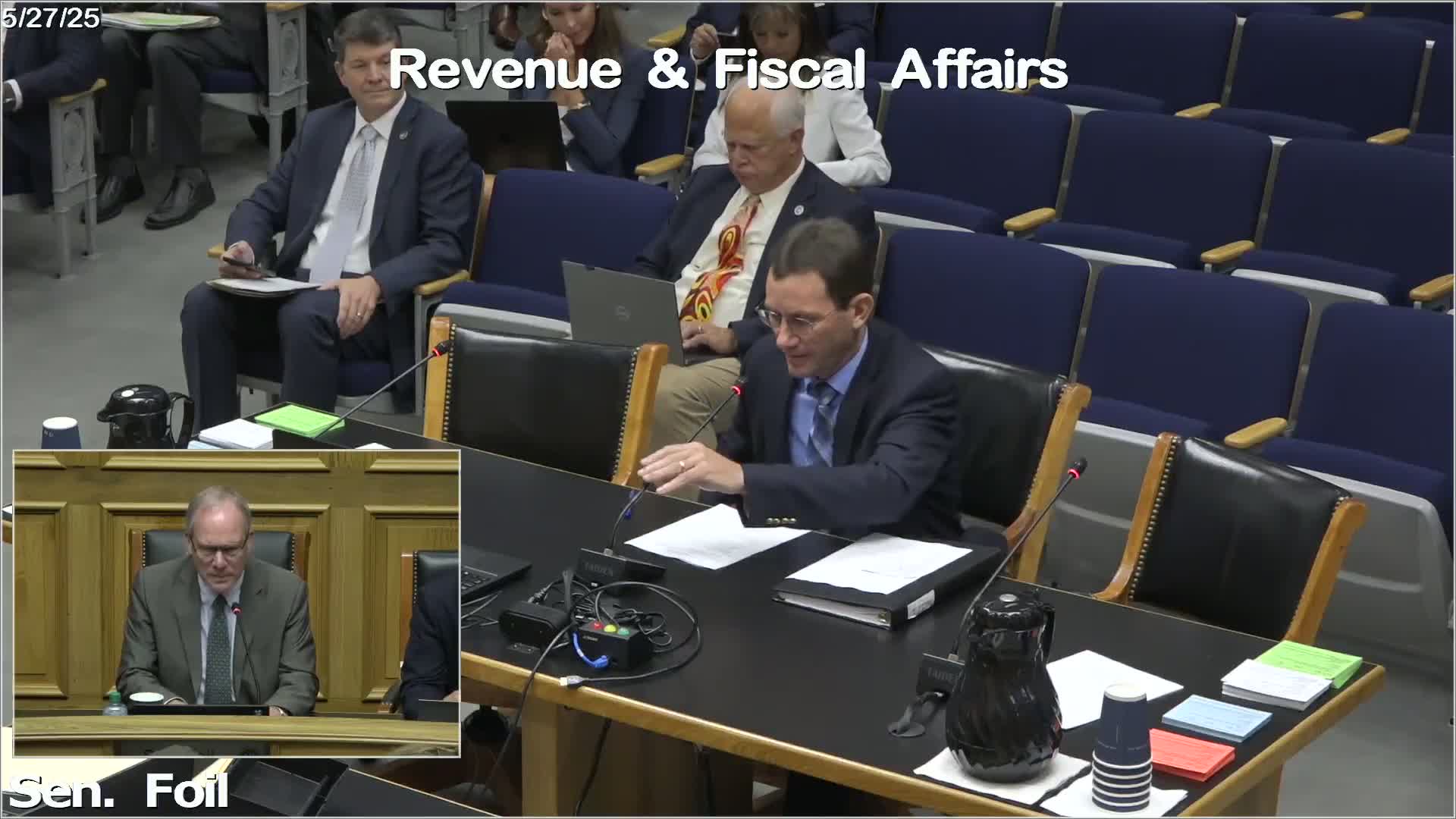
The Senate Committee on Revenue and Fiscal Affairs heard an overview of House Bill 2 (capital outlay) on May 27, 2025, from Roger Husser, assistant commissioner in the Division of Administration and director of Facility Planning and Control.
The Senate Committee on Revenue and Fiscal Affairs heard an overview of House Bill 2 (capital outlay) on May 27, 2025, from Roger Husser, assistant commissioner in the Division of Administration and director of Facility Planning and Control. Husser told the committee the bill was assembled around cash-flow needs and remains close to a statutory capacity limit for new cash lines of credit.
Husser said the statutory limit set in 1994 ― adjusted for inflation each year ― gives the state $552,000,000 in new cash line-of-credit capacity this year. “The capacity this year for new cash lines of credit is $552,000,000,” Husser said. He said the original HB2 submitted this year was just under $11 billion across all means of finance and that the version that passed the House stands at about $11.3 billion with 822 projects, up from 775 in the earlier draft.
Why it matters: Committee members pressed Husser on whether small cash infusions for many local projects can tie up funds for years without producing completed projects. Husser said that when cash is placed on a local project it can be tied up for a long time and that the administration cannot reallocate excess cash from one project to another without express legislative approval. Senator Morris asked for a committee-accessible list of previously funded priority-1 appropriations that remain unspent so lawmakers can consider reclaiming those dollars.
Most important facts: Husser said there is roughly $1.8 billion in older priority-1 appropriations that were not spent and reauthorized for subsequent years, and the bill includes about $297,000,000 of general-fund, direct nonrecurring cash combined with the $552,000,000 new capacity. He explained how the priority system (priorities 1–5) is intended to sequence cash needs, with priority 1 intended for the next fiscal year and priority 5 for out years. Husser estimated that, as assembled, the state projects in the bill amount to an eight- to nine-year plan while non-state projects represent a much longer horizon under current assumptions.
Committee questions and staff follow-up: Senators pressed Husser about whether the Division scrubbed older, unlikely-to-progress non-state projects from the bill before filing. Husser said the administration can more reliably assess state projects but has limited ability to judge which non-state projects will ultimately proceed; he said the division provided reporting on old appropriations so the legislature can make informed decisions. Senator Morris requested a list of projects with unspent priority-1 appropriations; Husser agreed to provide it.
Public comment: During the public comment period, Tracy Bryson, alderman and incoming mayor of Springfield, asked the committee to return a $2.8 million Springfield water-system project (previously moved from priority 1 to priority 5) to priority 1, saying the town is shovel-ready and has purchased land needed for sand filters. Bryson said Springfield’s municipal population is about 425 but the system serves surrounding areas.
Outcome and next steps: No formal committee vote on HB2 occurred at the hearing. The committee took testimony, requested follow-up materials from the Division of Administration (a detailed list of older unspent priority‑1 appropriations), and heard a public plea to restore a Springfield water project to priority 1. The chair indicated the committee will continue to consider HB2 and its amendments in the coming days.
Ending: The Division of Administration emphasized that further legislative focus on cash-flow prioritization and bill magnitude may be needed in future sessions to make the capital-outlay program more likely to deliver projects to completion.