Get Full Government Meeting Transcripts, Videos, & Alerts Forever!
Get email alerts on the Economic Development topic
No spam. Unsubscribe anytime.
House Commerce panel approves bill letting Louisiana Economic Development create innovation fund and transact land for projects
Summary
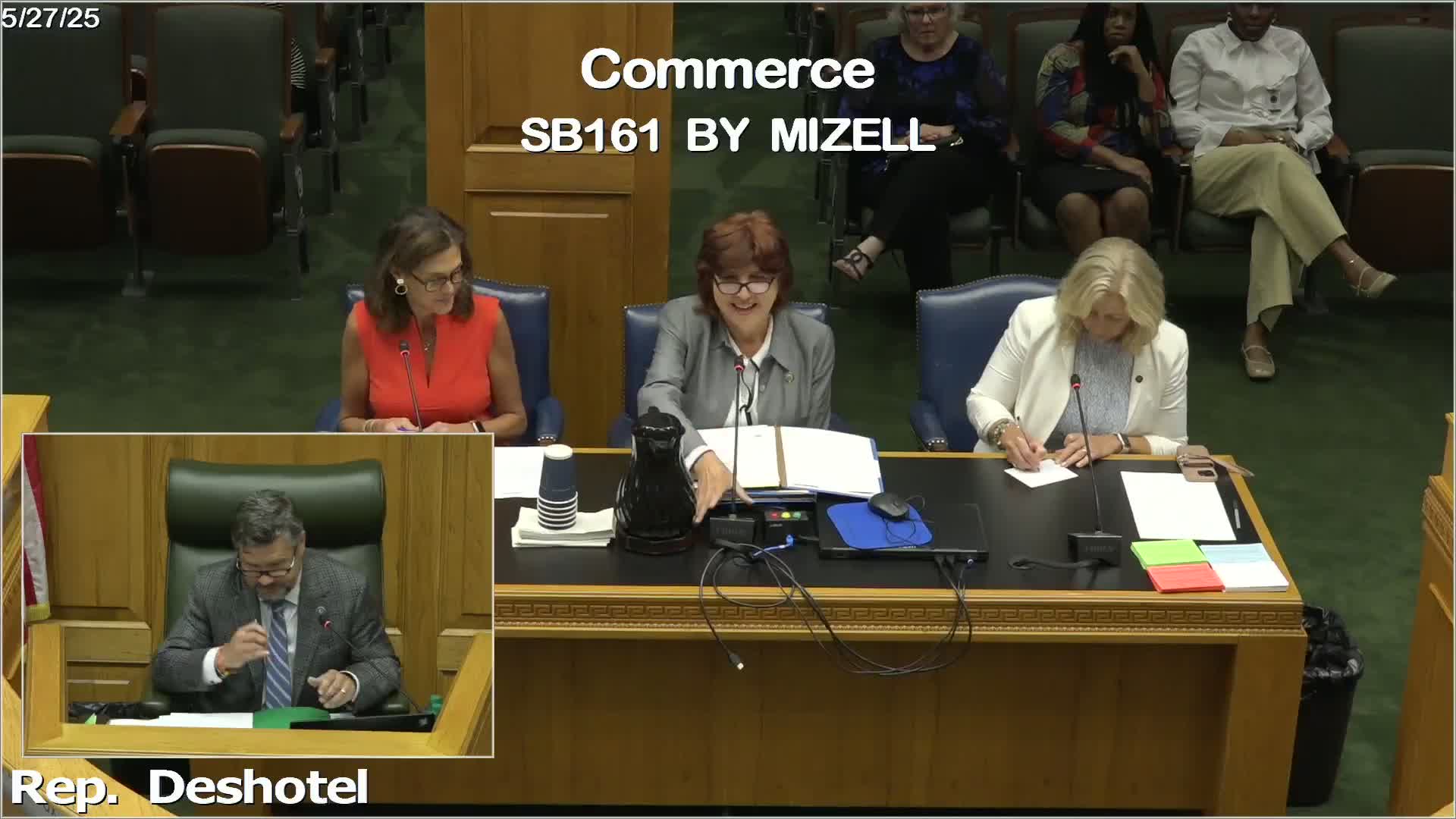
Senators and representatives on the House Committee on Commerce advanced Senate Bill 161 on May 27, approving language that creates a Louisiana Economic Development (LED) Innovation Fund and gives LED statutory authority to buy, sell, lease and sublease property for economic development projects.
Senators and representatives on the House Committee on Commerce advanced Senate Bill 161 on May 27, approving language that creates a Louisiana Economic Development (LED) Innovation Fund and gives LED statutory authority to buy, sell, lease and sublease property for economic development projects.
The bill, presented by Senator Mizell and explained by Susan Bourgeois of Louisiana Economic Development, would “create — it does not fund but it does create — a Louisiana economic development innovation fund,” Bourgeois told the committee. She said the measure also would give LED the ability “to lease, sublease, purchase and sell land as it relates to economic development projects.”
Why it matters: committee members said the changes are intended to make LED “move at the speed of business” and to close gaps left by last year’s reorganization of the department. Supporters described the authority as a tool to prepare and hold sites for future projects and to capture economic benefit when private developers pay LED under a lease or sale arrangement.
Key provisions and oversight
- Innovation fund: The bill creates an LED Innovation Fund as a statutory entity but contains no appropriation language. Bourgeois said the fund exists to let LED seek federal and other sources to support innovation activities.
- Real-estate powers: The bill would give LED clear authority to acquire, hold, lease, sublease and convey property for economic development. Bourgeois described the Richland Parish mega site used for the META project as an example of why the authority is needed.
- Special-purpose entities and oversight: An adopted amendment authorizes LED, with Division of Administration approval, to create single-purpose entities that can complete transactions on LED’s behalf. The amendment requires commissioner-of-administration review for leases, subleases or sales tied to the provision and gives oversight to the Joint Legislative Committee on the Budget (JLCB) once a transaction has been initiated. Anne Villa, deputy secretary and CFO at LED, said the special-purpose entities help isolate transactions for accounting and legal clarity.
Board and staffing changes
The bill also removes two offices that were created statutorily — the Office of Entertainment Industry Development and the Office of International Commerce — folding their functions into LED operations rather than separate budget line items. The measure restructures appointments to the Louisiana Board of International Commerce (LeBIC) to emphasize regional representation and adds two seats representing the state’s airports; a committee amendment increased the governor-appointed membership to include two airport representatives.
What the committee did
The committee adopted a set of technical amendments, approved substantive amendments that add Division of Administration and JLCB oversight for property transactions, and adopted the airport‑representation amendment. Representative Newell offered the substantive amendment; Representative Hilferty moved the bill out of committee; the measure was reported with amendments by unanimous voice action "seeing none."
Remaining questions and follow-up
Members pressed LED staff on how purchases would be paid for and on the procedural steps — appraisals, procurement and budgeting — that would precede acquisition. Bourgeois said LED’s purchase authority would be exercised within the appropriation limits the legislature provides and that larger transactions would require further budgetary approvals. Committee members also sought clarity about how nominations to the reconstituted LeBIC would be made; the bill prescribes regional and industry representation but does not prescribe which organizations must submit nominations to the governor.
The committee’s action sends the bill forward with the adopted amendments; it does not appropriate funding for the new innovation fund or change existing appropriation limits.