Get Full Government Meeting Transcripts, Videos, & Alerts Forever!
Get email alerts on the Water Management topic
No spam. Unsubscribe anytime.
Committee reports bill to create inland water coordination authority
Summary
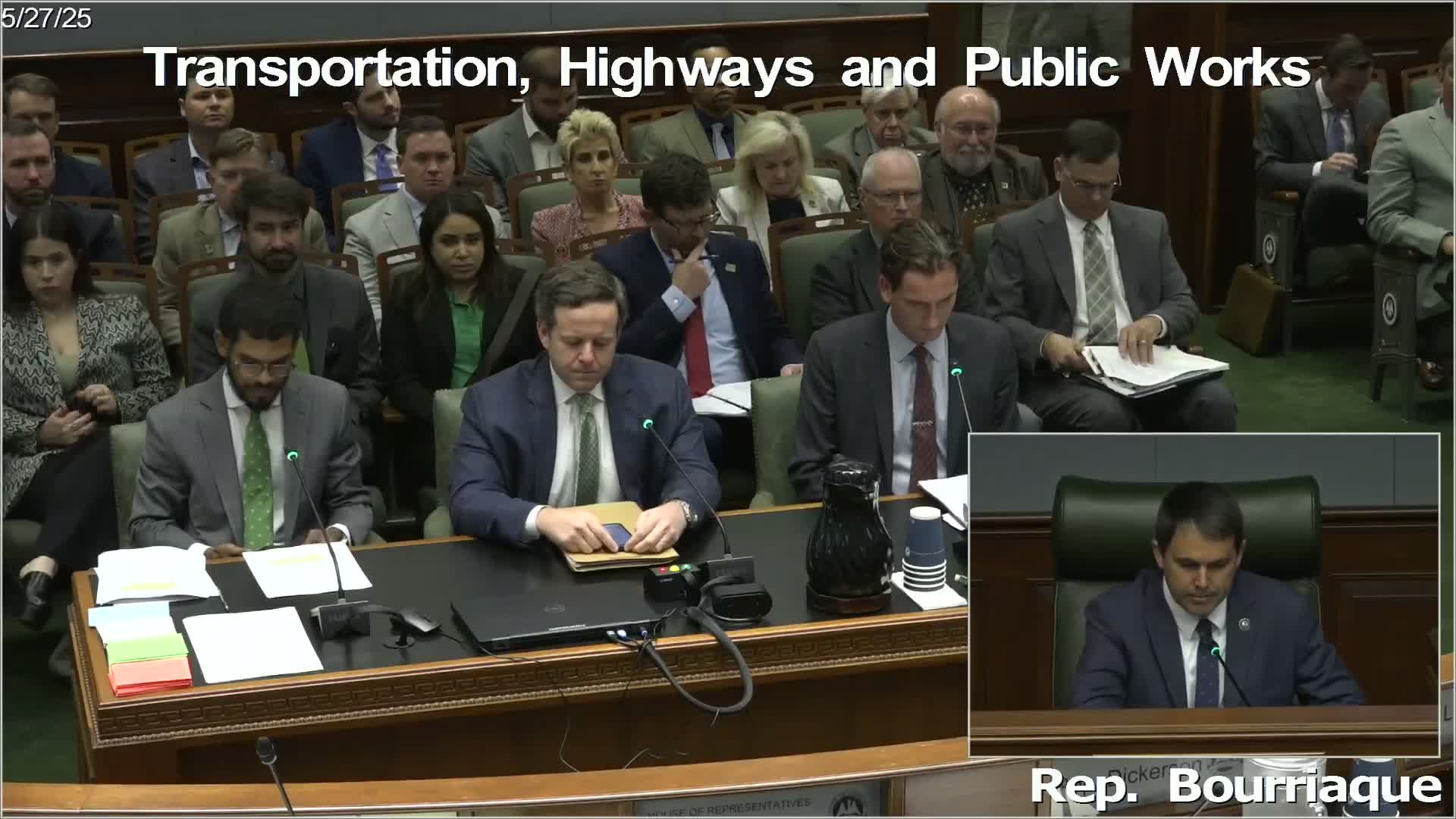
The House Transportation Committee on May 27 reported Senate Bill 97 favorably, a proposal to create a voluntary coordinating authority for inland water resources to support navigation, recreation and economic development while preserving local jurisdictions.
The House Transportation Committee voted May 27 to report Senate Bill 97 favorably, a measure authorizing a voluntary inland water coordination authority intended to help non‑coastal parishes plan river, levee and watershed projects for navigation, recreation and economic development.
The bill’s author, Senator Presley, told the committee, “We know that there are 2 main issues for economic development, that we're gonna face over the next 50 years. It's water and power.” The proposal would form a coordinating framework to compile planning data and help secure federal and state funding for multi‑parish projects.
Proponents said the authority is meant to create a planning arm that complements existing local entities rather than supplant them. Dustin Davidson, deputy secretary at the Department of Energy and Natural Resources, said the bill “does not take away any jurisdiction or supersede any other commission, port, municipality, public, political subdivision.” Steven Swiber, the state's chief resilience officer, described Louisiana’s coastal program as “truly a model program for the rest of the country” and said the bill seeks to replicate those planning and federal‑funding advantages for upland watersheds.
Opponents urged narrower language and stronger safeguards for private property and ecological protection. Matthew Allen, representing North Shore River Watch, said the measure “risks doing more harm than good, especially in regions like Saint Tammany Parish,” and asked for required baseline studies, stronger scientific justification, and longer public notice periods for large projects.
Committee members pressed for clarity on scope and authority. Representative Wiley asked whether the measure would affect entities that already have basin or levee structures; Davidson pointed to a clause in the draft (page 22) making clear the chapter “shall not be construed to diminish, impair, or impair the constitutional, statutory, or contractual authority of any levee district, drainage district, navigation district, [or] port commission operating within the upland area.” Senator Presley and staff said participation would be voluntary and the group’s deliverable would be an annual master plan submitted to the Department of Natural Resources and to the legislature.
Representative Chasson moved to report the bill favorably; no objections were raised and the committee ordered the bill reported favorably.
Supporters and opponents in testimony asked the committee to clarify (1) whether the authority would add permitting layers (proponents said it would not), (2) how members would be selected and chaired (the governor would appoint the chair from available members), and (3) public‑notice timelines (opponents requested extending notice from seven–10 days to 21–30 days for major projects). The committee indicated staff and stakeholders would continue work on notice and representation details during the legislative process.
Less critical details: speakers noted the bill is focused on non‑coastal parishes and is intended to help make projects shovel‑ready when federal funding becomes available; no new taxing authority was identified in committee testimony.