Get Full Government Meeting Transcripts, Videos, & Alerts Forever!
Get email alerts on the Criminal Justice Prosecution topic
No spam. Unsubscribe anytime.
State’s Attorney reports case growth, new training pathways and digital backlog
Summary
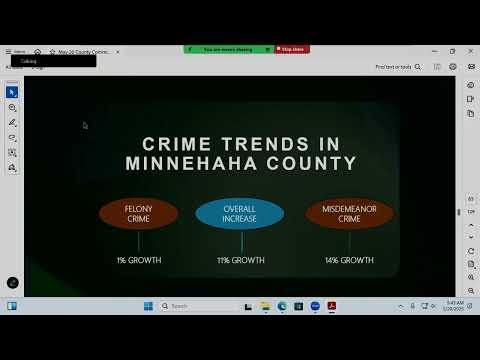
State’s Attorney Daniel Hager told the commission his office saw overall case growth, a spike in homicides, staffing turnover, expansion of prosecution practicum and an alternative licensure pathway with the law school, and ongoing digital discovery backlogs that will require staffing or technology solutions.
Minnehaha County State’s Attorney Daniel Hager told the county commission on May 20 that his office handled more criminal filings last year, faced staffing turnover, and is pursuing new training and recruitment efforts including a prosecution practicum and an alternative bar pathway in partnership with the law school.
Hager said, "we had... 11,324 adult criminal filings last year," and described the past year as "challenging" because of turnover among prosecutors even as some moved into judgeships or other offices.
The nut of Hager’s briefing is that public-safety workload has risen while the office manages recruitment, training and technology upgrades to keep pace. He outlined the office’s strategies and several operational pressures that could shape FY26 budget requests.
Hager said the office reorganized felony teams to align prosecutors with judges and to prepare for complex homicide prosecutions. He cited State v. Darion Johnson as an example of a recent trial that "represented a lot of what we're seeing in the county," and recognized staff who obtained convictions in that case.
On diversion programs, Hager reported measurable outcomes. He said the office had "408 successful diversions last year" for early diversion programs tied to substance use and other interventions. For adult diversion he said there were "309 participants" with "219 successful so far" and roughly 22 not successful. He added that 85 individuals who completed diversion programs remained crime-free after a year.
Hager described training and recruitment initiatives: a prosecution practicum with the law school had produced hires in prior cohorts and the office will begin an alternative pathway that could allow participating law students to practice in the office with a minimum two-year public service commitment in lieu of immediate bar passage. He said, "we will have students who are gonna spend an entire semester in the Minne County State's Attorney's Office" and that three students will start the alternative pathway this fall with supervised courtroom responsibilities.
Hager highlighted technology and workspace changes: the office went paperless in 2023 and repurposed a vault into a trial advocacy courtroom to train prosecutors and prepare witnesses, including juveniles, "in a courtroom setting without the pressure of everything that's going to come ultimately when they're actually in court." He said the office expects the new trial training space to help witness preparation and trial performance.
On digital evidence, Hager said the digital discovery team is understaffed and described a backlog in downloading video and other digital material. He said one digital discovery technician left for federal work and another staffer would start in June; the office is considering technology solutions or additional staff to address the backlog.
Hager also discussed recent legislative changes. He said the legislature reduced ingestion of controlled substances from a felony to a misdemeanor for the first two convictions, and that his office participated in drafting Senate Bill 116 addressing unlawful street racing. He said the ingestion change "tied into" specialty-court options and probation programs and that his office hopes the change has its intended effect.
Commissioners praised the prosecution practicum and the alternative pathway as ways to stabilize hiring. Commissioners asked questions about staffing levels and recidivism tracking; Hager said some data will be available but cautioned that tracking recidivism requires intensive data work and that the office moved to a new case management system in 2023. He also said charging grand jury work needs immediate help and that juvenile crime complexity may require an additional lawyer down the line.
Hager said the office will ask the commission to convert two over-hire positions to full-time in coming budget requests and ended by thanking county departments and partners. The commission did not take formal action on the briefing; it was received for discussion.