Get Full Government Meeting Transcripts, Videos, & Alerts Forever!
Get email alerts on the Public Safety Compensation topic
No spam. Unsubscribe anytime.
Town staff proposes step-based pay plan for sworn police and firefighters to improve recruitment and retention
Summary
Human resources presented a proposal to adopt a step-based, performance-linked pay plan for sworn police and fire personnel beginning in fiscal year 2026. Staff said the change aims to match competitor cities, reduce turnover and simplify recruitment; details and fiscal impacts will come through the FY26 budget process.
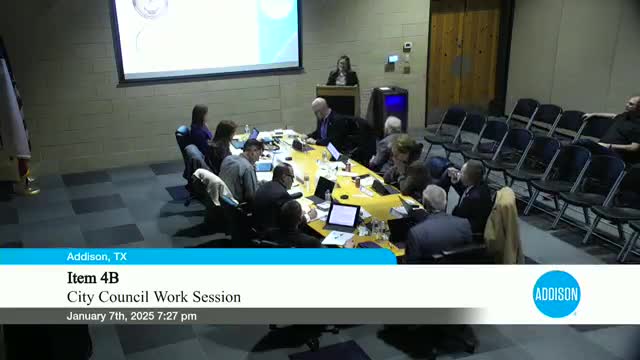
Ashley Wake, director of human resources, told the council staff is recommending a step-based, performance-linked pay plan for sworn police officers and firefighters beginning in fiscal year 2026. "Provided the challenges, market competition, and the town's strategic objectives, staff evaluated and recommend moving to a step based performance pay plan for sworn police and fire beginning in the fiscal year fiscal year 26," Wake said.
Wake said the town's 2023 town-wide classification and compensation study had placed police and fire pay above comparator-city averages at that time, but rapid changes in neighboring cities have since placed Addison behind the market. Staff described recruiting problems and turnover among early-career public-safety employees and noted recruitment callers frequently ask for a step plan that is visible on recruitment materials. Staff presented an example step structure tied to annual performance reviews and said the town would initially assume a 4% market adjustment in FY26 and phase personnel into steps based on current salary and years of service. Wake said lump-sum adjustments for topped-out employees would not be included unless one-time funds become available.
Fire Chief David Jones and Police Chief Alexander (police chief; first name not specified in the transcript) joined the discussion. Chief Jones said the fire department ran about 4,300 calls last year across two stations and that roughly 60–65% of calls are emergency medical service responses. Both chiefs said a visible step plan would help recruits and lateral candidates understand career progression. "When they look at us, we are a busy department," Jones said. The police chief and other leaders said the step plan would remain performance-based: supervisors would withhold step progression for employees who fail to meet expectations or who have disciplinary issues.
Council members asked about prior attempts to adopt a step plan, how merit would be incorporated, training and time-to-top-out, and fiscal impacts. Staff said training for public safety hires can require 12 to 18 months, that competitor cities typically reach top pay more quickly (staff cited an average three- to five-year top-out in nearby cities), and that the implementation would be phased to limit FY26 budget impacts. Funding would come from the general fund (property taxes and other general fund revenues); staff said specific dollar amounts and the net fiscal impact would be developed as part of the FY26 budget process.
There was broad council interest in pursuing the proposal through the budget process. Staff asked whether council wanted the issue included in the FY26 budget discussions; several members said yes. No formal council vote was taken at this meeting; staff will return with detailed budget figures, a staffing study and a recommended step structure during the FY26 budget process.
Ending: Staff will work with the budget team and public-safety leadership to model fiscal impacts and bring a detailed recommendation and resolution for council consideration during the FY26 budget process.