
Enrollment growth and teacher shortages drive West Clermont planning: district projects 280–355 more students in coming years
Get AI-powered insights, summaries, and transcripts
Subscribe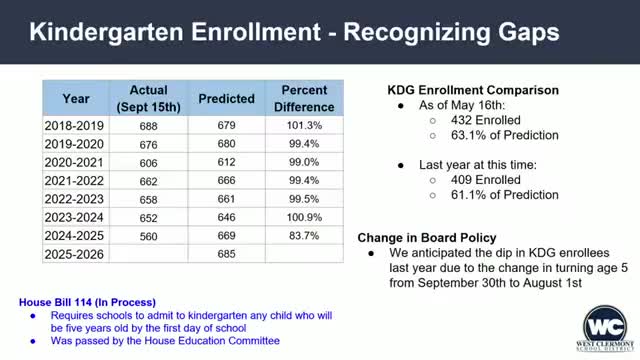
Summary
District administrators told the board on May 19 that projected residential development will add several hundred students over the next three years and that recruiting and retaining teachers remains challenging.
District administrators told the school board on May 19 that West Clermont faces mounting enrollment growth over the next three years and that recruiting and retaining fully certified teachers is increasingly difficult.
Forecasts and causes: The district presented PowerSchool predictive analytics showing residential development as the primary driver of projected student increases: staff said the forecast anticipates an additional 280 students in 2025–26, 291 in 2026–27 and 355 in 2027–28. Administrators said Amelia, Clough and Withamsville Tabasco elementary attendance zones account for most of the projected elementary growth.
Why it matters: Staff warned that space shortages are already tangible and will intensify as projected students arrive. The district listed options to manage capacity, including modular classrooms, attendance‑boundary changes, staggered start times, repurposed or leased space, and programmatic changes such as half‑day kindergarten or larger class sizes. Each option has trade‑offs for instruction, transportation and community response.
Teacher recruitment and retention: District recruiters reported active outreach at university career fairs, using Title II data to target institutions and conducting 121 candidate engagements and 52 first‑round interviews this year. Forty‑four candidates signed up for email notifications, and two offers had been extended from career‑fair contacts, with one accepted (a special education teacher from Miami University). The district also reported hosting 39 student observers and 51 student teachers this year; four student teachers have been hired into district roles to date.
Attrition and staff climate: The district provided attrition data and Gallup engagement survey results. Staff said statewide teacher shortages remain severe and that Southwest Ohio’s attrition rate was approximately 14.5% (district staff used that regional figure for comparison). The district reported its own overall turnover rate had come down in recent years to near 4.7% (from higher historical levels), and that the largest single reason staff cited for leaving this year was family or personal needs (32% of departures categorized that way). Gallup survey responses showed gains in employee engagement and in measures such as staff development and workplace relationships.
Short‑term mitigations and long‑term planning: Administrators urged the board to consider both immediate mitigation measures (modulars, redistricting, schedule adjustments) and long‑term facilities or ballot options to keep up with growth. Staff said some mitigations — for example, modular classrooms — require architect involvement for engineering, permitting and code compliance.
Ending: The board asked staff to return with more granular cost options tied to boundary changes, staggered schedules and the impacts of program reductions; staff emphasized that any staffing or program reductions would be quantified and returned to the board for review before implementation.