
Central Fire, Capitola Police and OR3 describe unified command, urge preparedness after recent incidents
Get AI-powered insights, summaries, and transcripts
Subscribe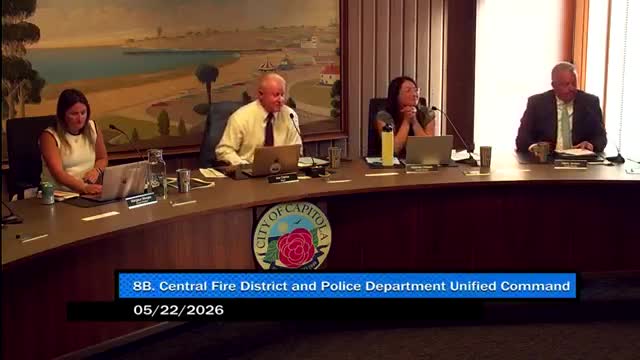
Summary
Central Fire, Capitola Police and the Santa Cruz Office of Response, Recovery and Resilience outlined how a unified command operates, described mutual‑aid resources and urged residents to join CERT or other volunteer programs; chiefs also noted coordination needs around battery‑storage incidents raised during public comment.
On May 22, 2025, Central Fire, the Capitola Police Department and the Santa Cruz Office of Response, Recovery and Resilience (OR3) briefed the Capitola City Council on how a unified command for emergencies is formed, how mutual aid is coordinated and which community preparedness steps the public should take.
The presentation explained that unified command brings fire, police and other agencies together at one location to coordinate tactics, resources and communications during incidents that exceed local capacity, and emphasized routine multi‑agency training and annual scenario exercises to build “muscle memory.”
Central Fire Chief Jason Nee described the initial central‑fire response to a confirmed structure fire as “five fire engines, one ladder truck and one battalion chief” and said that first‑alarm response typically brings about 20 personnel to a confirmed structure fire in the Capitola area within about seven to eight minutes; a second alarm brings roughly a matching set of additional resources and a third alarm is the largest mutual‑aid activation available in the county.
Chief Nee said, “We are small and so we do depend on our partners to assist with us,” and he and presenters described how agencies use the county emergency operations center (EOC), GenZ/ZoneHaven evacuation mapping and Red Cross for sheltering. The presenters noted that modern social media speeds dissemination and that incident messaging aims to be accurate without overcommunicating so residents will act when officials issue evacuation or shelter orders.
Council members asked for specific follow up: several asked staff to return with an informational packet describing volunteer options (including CERT), county VOAD coordination, how to request or deploy message boards and how the city plans to update its emergency operations plan. OR3 said the county maintains a Volunteer Organizations Active in Disaster (VOAD) structure and encouraged residents to join the county CERT program; Red Cross participation and county volunteer coordination were described as the preferred mechanisms to avoid spontaneous volunteerism creating secondary problems.
Public commenters had raised concerns earlier in the meeting about lithium‑ion battery storage facilities, citing the Moss Landing fire and calling for more testing, public information and first‑responder support. Presenters acknowledged those concerns and said that coordination with county partners and appropriate technical experts is part of response planning, and that firefighters and police are engaged in ongoing training and planning for hazardous events that may involve toxic smoke or unfamiliar hazards.
Council members requested that staff explore grants and funding to add message boards at key village entrances, asked for a short informational item back to council on OR3 volunteering and CERT coordination, and requested annual community training or tabletop exercises to demonstrate unified command operations to the public.
No formal council action was required; council members expressed support for continued multi‑agency training, outreach and for staff to return with specific volunteer and public‑information plans.