
Tag narrows humidification rules after debate on health, energy; agrees 50% cap in hotter climates
Get AI-powered insights, summaries, and transcripts
Subscribe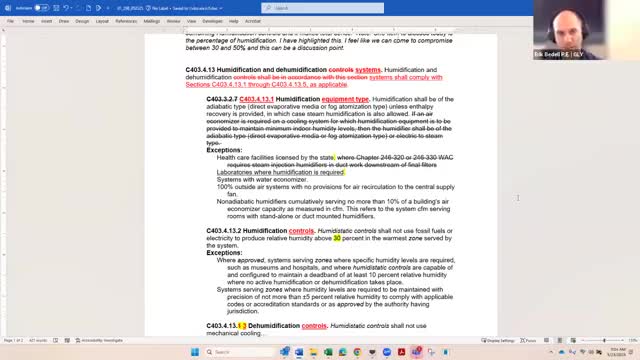
Summary
The TAG approved rewritten humidification and dehumidification language that simplifies duplicate sections, keeps adiabatic humidification as the primary option, and sets different maximum relative‑humidity caps by climate zone (30% in drier zone 4c, 50% in warmer zone 5b) after debate over health impacts and energy use.
The Washington State Building Code Council’s Commercial Energy Code TAG approved changes to the 2024 energy code sections addressing building humidification and dehumidification, adopting a rewrite that combines system‑ and control‑requirements into one section and sets humidity caps targeted by climate zone.
The TAG voted 10‑5 with one abstention to approve the revised proposal after a long discussion that focused on the energy penalty and health impacts of higher indoor relative humidity. Proponents said higher humidity can reduce airborne virus persistence and improve occupant health; opponents warned of energy cost and equipment‑efficiency tradeoffs.
“This is not about prohibiting humidification to an appropriate level,” said Dwayne Johnlin as he explained the proposal’s focus on equipment efficiency. Mechanical engineer Larry Andrews pushed for a 50 percent relative‑humidity cap in warmer climates, citing public‑health literature and practitioner recommendations. “Everybody is telling you, if you want a healthy building, you need 50% humidity,” he told the TAG.
The TAG’s compromise sets a 50 percent maximum in the warmest climate zone served by a system (climate zone 5b) and a 30 percent maximum in cooler/drier zones (4c) where steam systems are more energy‑intensive. The approved language also removes a prior third‑party commissioning requirement (retaining commissioning but not requiring a third‑party provider), clarifies exceptions for laboratories and health care spaces, and consolidates the requirements into a single code section for clarity.
Proponents said the change balances energy concerns and health needs while giving design teams clearer code language. Opponents continued to caution about enforcing the new limits across diverse building types and the need to specify equipment and water‑treatment requirements for adiabatic systems.
The TAG directed staff to carry the adopted language forward to MVPE with editorial cleanup and to ensure cross‑references to other commissioning and metering sections were correct.