
San Diego Community Power previews $1.2 billion budget, proposes $21.4 million capital investment and $18.8 million solar‑battery program
Get AI-powered insights, summaries, and transcripts
Subscribe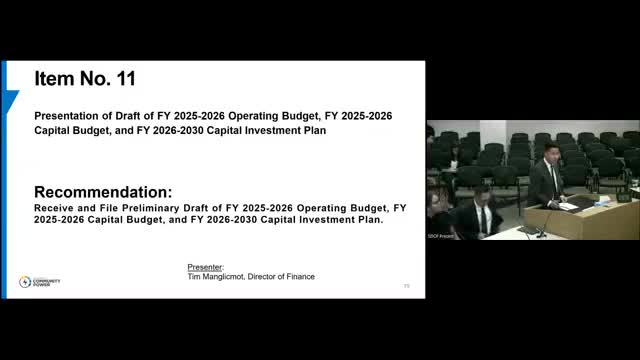
Summary
San Diego Community Power on a May 2025 regular meeting at the Port of San Diego Administration Building received a preview of its draft FY2025–26 operating budget, the FY2025–26 capital budget and a FY2026–2030 capital investment plan and asked staff to return in June with a recommendation to adopt the budgets for the fiscal year beginning July 1.
San Diego Community Power on a May 2025 regular meeting at the Port of San Diego Administration Building received a preview of its draft FY2025–26 operating budget, the FY2025–26 capital budget and a FY2026–2030 capital investment plan and asked staff to return in June with a recommendation to adopt the budgets for the fiscal year beginning July 1.
The draft, presented by Timothy Nagamal, director of finance for San Diego Community Power, projects roughly $1.2 billion in revenue and proposes a one‑time transfer of about $21.4 million into the capital investment plan, including about $18.8 million proposed for a continuation of the agency’s solar‑battery savings program. "This year's budget continues to grow reserves," Nagamal said as he summarized the document to the board.
Why it matters: the operating budget and capital plan fund the agency’s energy purchases and local programs and set staffing and reserve targets that affect rates and program continuity for customers. The board discussed market volatility, potential federal policy changes affecting tax incentives, and the need to protect vulnerable customers while the agency pursues longer‑term reserve and renewable goals.
Key facts and details
- Revenue and major line items: Nagamal said the packet reflects a revenue budget of about $1.2 billion. He told the board that cost of energy remains the largest single line (roughly 95% of the agency’s expenses) and that the draft shows a year‑over‑year decrease in the energy expense line of roughly $160 million compared with last year’s budget. Non‑energy operating expenses were described as roughly flat year‑over‑year.
- Reserves and net income: The presentation shows a planned net income contribution the finance team characterized as consistent with earlier projections and said the agency has a high likelihood of reaching the board’s 180‑day reserve target in the coming year if current assumptions hold. "We do anticipate that we will hit that hundred 80 days," Nagamal said, noting reserves will ebb and flow with market conditions.
- Capital investment plan (CIP): The draft includes a proposed $21.4 million appropriation into the CIP for one‑time projects. The largest single CIP item in the packet is the solar‑battery savings program, with a proposed appropriation the presenter identified as about $18.8 million to continue the program this year.
- Solar‑battery savings program: Staff described the program as creating demand for local solar contractors and delivering grid and customer benefits by enabling battery discharge during evening peak hours. Public speaker Jake Marshall, manager of Green Tech Renewables, told the board the program helped local contractors survive a difficult market period and bolstered his business. "So I am in heavy support of the solar battery savings program," Marshall said during public comment, adding that the program supported local jobs.
- Staffing and professional services: The draft would increase authorized full‑time positions to about 94, an increase of seven positions compared with the prior authorized level (87). Staff said some cost increases reflect positions hired in the current fiscal year that will be annualized in FY2025–26. The presentation and directors’ questions signaled a request for more detail on proposed new positions, comparable salary data, and a breakdown of professional services and consultant contracts.
Board discussion, concerns and direction
- Market and federal policy uncertainty: Directors asked how the budget accounts for volatility in energy markets and for potential federal changes to tax incentives (ITC/PTC). Staff said they model multiple scenarios, use conservative budgeting, and intend to rely on reserves and risk management tools to absorb shocks. Director Yamani requested a June update focused on federal policy impacts.
- Equity and customers with greatest need: Several directors pressed staff to show how budget choices and program funding will protect vulnerable customers, and to consider reallocating some outreach/marketing dollars to assist customers who need program navigation. Staff agreed to return with more detail on customer‑facing program budgets and outreach metrics.
- Follow‑up requests from directors: Directors asked staff to provide (1) a personnel detail showing new positions, duties and comparable salary data; (2) a spreadsheet of professional services/consultant contracts and costs; and (3) CIP priority sequencing for one‑time investments.
Public comment and stakeholder input
Jake Marshall, manager of Green Tech Renewables, spoke in support of the solar‑battery savings program and said the program had provided critical demand for local contractors during a transition period in the solar market. Several board members praised the Community Advisory Committee for continuing outreach and program feedback.
Decision and next steps
The board received the draft budget and CIP for review and comment (receive and file), and asked staff to return in June with a recommendation for adoption, plus the follow‑up materials requested by directors. Final adoption is scheduled for the board meeting next month; staff emphasized that the packet presented in May was a preview and not a final adopted budget.