
New state road-funding law reduces Community Crossings grants and ties new distribution to wheel tax, county highway director warns
Get AI-powered insights, summaries, and transcripts
Subscribe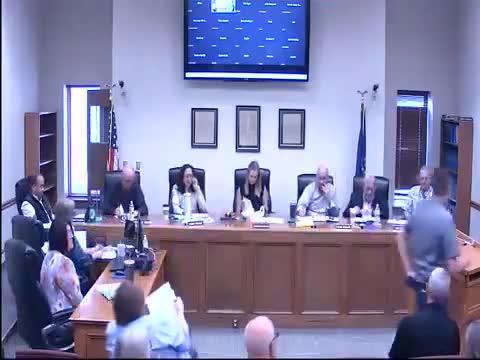
Summary
Boone County Highway Director Nick Barr told council that a recently passed state road-funding bill reduces the Community Crossings pot and ties a new distribution to jurisdictions that adopt a wheel tax, creating both funding uncertainty and a potential local tax choice.
Boone County Highway Director Nick Barr briefed the council on changes in state road funding that will affect local budgeting and project planning after the passage of the road-funding bill discussed at the meeting.
Barr said the Community Crossings program — which historically paid 50% of construction on many local bridge and preservation projects — was previously supported from an approximately $350 million pot. The bill reduced the portion available to Community Crossings to $100 million, a significant cut that means fewer awards and unpredictability for county budgeting. Barr told the council that the program’s administering agency advised not to expect the former top award amounts or regular annual caps.
The legislation also directs $50 million to Indianapolis for road projects (with matching requirements and use restrictions) and $20 million annually to a program addressing at-grade railroad crossings. Barr emphasized the remainder is to be distributed to counties and qualifying cities and towns by a new formula based on lane miles rather than road miles.
Crucially, Barr said, the new distribution is available only to jurisdictions that adopt a wheel tax (a fee charged at vehicle registration). He warned county officials that, while the wheel-tax distribution could bring significant revenue (an illustrative estimate from Purdue’s LTAP showed Boone County might receive about $867,000 annually under a hypothetical statewide adoption scenario), the new scheme also imposes a new tax on vehicle registrations and makes funding levels dependent on how many other jurisdictions adopt wheel taxes.
Barr said the change will force the highway department to revise budgeting assumptions: “The significant reduction in Community Crossings is gonna have an impact immediately on budget. Absolutely. We won't be able to budget for that $1,500,000,” he said, referring to historical local expectations. He added that the new distribution’s amount is uncertain and cannot be relied on as a stable budget line until jurisdictions decide whether to adopt wheel taxes.
Why it matters: The two-part change — less Community Crossings funding and a new wheel-tax–conditioned distribution — changes how Boone County must plan and budget for preservation, bridge and small-structure projects and creates a policy choice for the council about whether to authorize a wheel tax to access the new revenue stream.
Next steps: Barr requested further council discussion; the county will invite technical presenters (LTAP and other experts) to explain wheel-tax structures, distribution formulas and likely revenue under different adoption scenarios before council votes on any wheel-tax ordinance.
Quotable: “That additional revenue…that turns into, we don't know. So do we need a wheel tax to keep functioning as we currently are? No. We're able to take care of our assets. We're not expanding, but we're able to take care of the assets,” Barr said, adding that reduced Community Crossings funding will reduce funds available for preservation work.
Follow-up: The council scheduled a future presentation from LTAP and TIF staff to review the bill's details and potential local impacts on revenue and budgeting.