
Municipal advisers present fund-balance, debt and financing options as city plans a five-year forecast
Get AI-powered insights, summaries, and transcripts
Subscribe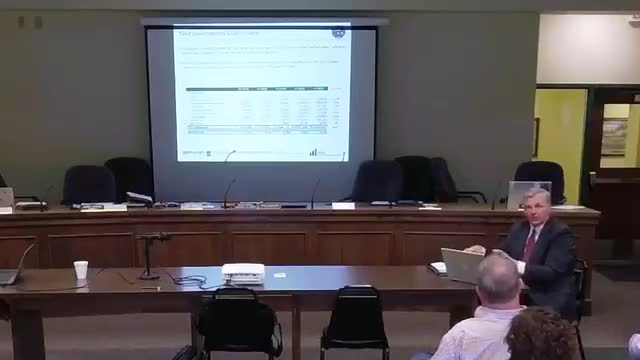
Summary
MAS Financial and Davenport Financial presented a comprehensive financial review to New Franklin’s finance committee, reporting growth in fund balances, a minimal debt profile, and the need to plan for roughly $10–15 million of capital work that may require future borrowing.
New Franklin’s finance committee heard a comprehensive financial review from municipal advisers MAS Financial and Davenport Financial that laid out the city’s recent revenue gains, a low current debt load and options for financing future capital projects.
The advisers summarized five years of audited data and told the committee the city “has been able to more than double its fund balances,” a result the presenters attributed to income-tax and property-tax growth and federal COVID relief funds. They also said the city’s unassigned fund balance was about 10% of revenues in fiscal 2023 and that its available fund balance (unassigned plus assigned/committed) was roughly 30% of revenues in that year.
The presentation’s nut graf: those savings have improved the city’s fiscal standing but, measured against a peer group of Ohio cities and typical rating-agency expectations, the city still falls short on some benchmarks. The advisers said the growth that produced recent savings may slow and urged the city to build formal financial policies and produce a five-year forecast before pursuing major debt.
Top-line findings presented to council included: fund balances more than doubled over five years; fund balances measured as a percent of revenue remain below the peer median; the city currently has a minimal debt profile; and the city faces roughly $10–15 million in identified capital needs over the next three to five years, some of which already carries grant support. As the advisers put it, “the city has a minimal existing debt profile,” which helps its credit position now but also means the city has little existing borrowing capacity to allocate to new projects.
Advisers discussed three principal ways the city could obtain financing for capital work: direct bank loans (private placements), a public sale of bonds (municipal bonds sold through an underwriter), and subsidized state or federal programs (for example, USDA or state water loan programs such as Ohio Water Development Authority or Ohio Public Works Commission for project-specific loans). The advisers cautioned lenders will look at four credit components: economic base, financial performance and flexibility, debt burden, and management practices.
They recommended a short program of next steps: build the five-year forecast, revisit formal financial policies (especially a tailored fund-balance policy), and continue municipal-adviser support during any tax-increment-financing (TIF) or debt-planning work. The advisers also noted that rating agencies commonly target available fund balances near 30% for Ohio income-tax–dependent governments and that Ohio’s reliance on income tax makes local governments particularly sensitive to revenue volatility.
Committee members asked about year-to-year variation and how federal one-time funds and wage increases factor into forecasts. The advisers said audited FY2023 financials were the basis for the model and that FY2024 inputs would be added “as soon as the audited financials are done.” They also cautioned that some federal COVID/ARPA and workers’ comp monies remain committed but unspent in many municipalities and that such timing artifacts can distort peer snapshots.
The presentation closed with an offer to return later in the year with a formal five‑year forecast and proposed financial policies. The advisers said they would remain available should the city seek a credit rating or pursue financing tied to a capital plan.