
Kerr County sheriff seeks to use Senate Bill 22 money for jail equipment, staff and medical costs
Get AI-powered insights, summaries, and transcripts
Subscribe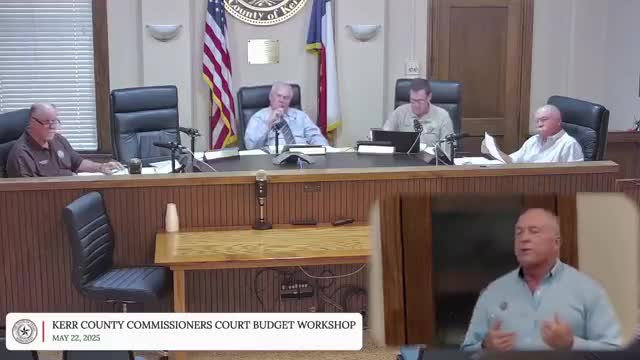
Summary
Sheriff Larry asked commissioners to spend portions of Senate Bill 22 funds on equipment, staffing changes and jail medical costs, including a request to buy a body scanner and to reclassify and add positions; he said some requests would be covered by non‑tax revenues such as out‑of‑county housing and seized funds.
Sheriff Larry, speaking to the Kerr County Commissioners Court during a budget workshop, asked the court to let him use Senate Bill 22 funds and other non‑tax revenues to cover law enforcement equipment, jail staffing and medical costs. He said he is "basically asking $270,000" from the Senate Bill 22 allocation and proposed several other draws on non‑tax funds.
The sheriff put several specific items before the court, saying he wanted to buy an in‑jail body scanner and replace in‑car computers. On the scanner he said: "Body scanner is hardly $85,000."
Why it matters: the sheriff argued the county’s jail population and medical needs are rising and that contracted medical services are increasing. "This is a lot of money to me, $264,000," he said when describing the projected rise in the jail’s contracted medical costs. He said the jail averages several hundred inmates and that contracted provider Wellpath had proposed a substantial increase; he described Wellpath as a key jail medical vendor.
Most important facts: the sheriff told the court he expects out‑of‑county housing revenue to remain an important non‑tax revenue source and offered to reimburse certain items from those receipts. He said some requests are expressly not tax‑payer funded: "None of this is tax payer money. This is all set of bill money." He also described a request to reclassify three existing employees into a new administrative division and to create a part‑time civil deputy paid from Senate Bill 22 money.
Details and supporting information: the sheriff gave a multi‑part list of uses for the Senate Bill 22 funds, including a $283,084 total request referenced in the discussion for multiple jail and equipment items (transcript figures were given in oral remarks). He explained he had applied for grants (including a $72,250 grant for car computers and a $70,740 body‑armor grant) and said he planned to finance some vehicle and technology purchases with a combination of grant proceeds, seizure funds and operational funding.
Commissioners asked several questions about the permanence of any salary changes funded by SB 22 money and whether stipends would be rolled into base pay if the dedicated funds disappear. Sheriff Larry responded that some earlier increases had been written so that, if the SB 22 funds go away, the stipend portion would revert: "If that money goes away, sign the letter, salary goes back to what it is."
The sheriff also asked the court to approve one new jailer to allow him to move toward nine‑person shifts and to help with out‑of‑county housing management, and he described efforts to raise out‑of‑county housing daily rates to increase revenue. He described one financing option for a body scanner the vendor had offered: financing for two years with no interest or extra fees.
Ending: Commissioners asked staff to confirm exact dollar amounts and legal constraints on using SB 22 funds, and several members pressed for written documentation showing which increases would be permanent and which would be stipend‑based. The court did not take a formal vote during the workshop; the sheriff’s requests will return with more detailed line‑item and legal clarifications.