
California officials vow to sue after Senate uses Congressional Review Act to rescind EPA waivers for vehicle standards
Get AI-powered insights, summaries, and transcripts
Subscribe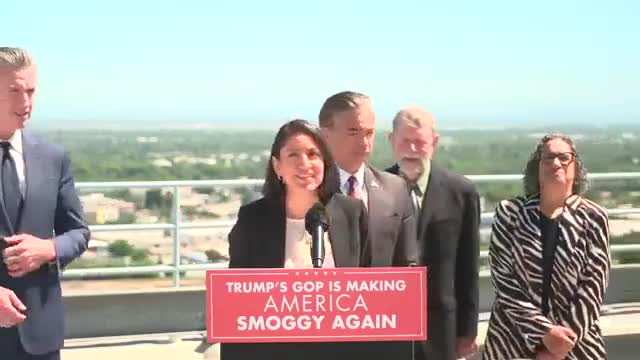
Summary
California Governor Gavin Newsom, Attorney General Rob Bonta and state environmental officials announced plans to sue the Trump administration after the U.S. Senate used the Congressional Review Act to rescind EPA waivers that allowed California to set its own vehicle-emission standards.
California Governor Gavin Newsom, Attorney General Rob Bonta and state environmental officials announced plans to sue the Trump administration after the U.S. Senate used the Congressional Review Act to rescind EPA waivers that allowed California to set its own vehicle-emission standards.
The officials said the Senate action undermines California’s long-standing authority under the federal Clean Air Act and threatens public health, the state’s electric-vehicle market and jobs tied to clean-vehicle investment. Attorney General Rob Bonta said, “We intend to sue the Trump administration over the unlawful use of the Congressional Review Act.”
At a news briefing at the California Environmental Protection Agency, Yana Garcia, California Secretary for Environmental Protection, framed the dispute as part of a broader fight to protect clean air and public health. “We will fight this illegal attempt to overturn California’s waivers and challenge our authority under the Clean Air Act,” Garcia said, adding that recent climate-driven disasters and wildfire costs in California total roughly $16,000,000,000 per year as she explained the stakes.
Dr. John Balmes, a pulmonary and critical-care physician who serves on the California Air Resources Board and is a professor of medicine at the University of California, San Francisco, told reporters the state’s vehicle rules have delivered measurable public-health benefits. “There simply wouldn’t be electric vehicles without our rules,” Balmes said, and he cited university studies tying greater electric-vehicle penetration to reductions in asthma-related emergency visits and in pollutants such as fine particulate matter and nitrogen dioxide.
Liane Randolph, chair of the California Air Resources Board (CARB), called the Senate votes “a direct attack on the health of Californians,” and said federal waivers granted under the Clean Air Act have allowed California to adopt standards that produced large air-quality gains over decades. Randolph and other speakers cited research and state estimates saying California’s clean-vehicle rules contribute to roughly $45,000,000,000 in avoided health-care costs.
Bonta said the state would bring a legal challenge contending the Congressional Review Act (CRA) was not intended to invalidate EPA waivers. He pointed to determinations by the Government Accountability Office and the Senate parliamentarian — which he said concluded the CRA does not apply to EPA waivers — as part of the legal basis for the lawsuit. “We have a well thought out complaint. We’re ready to file at any moment as soon as the action is final,” Bonta said.
Officials described the planned litigation as part of a pattern: Bonta said it would be the state’s 23rd suit against actions by the Trump administration and argued the CRA had never before been used to target Clean Air Act waivers. Newsom said the action threatened California’s competitiveness and innovation in the electric-vehicle market and called the Senate move a “nuclear option” that overturned long-standing processes.
Speakers also said the rescission could have ripple effects on state budget calculations and programs; Newsom said state officials would soon “socialize in detail” potential direct impacts on the budget, including how federal changes could affect tax credits, registration fees and other items.
Officials emphasized the state will proceed with regulatory planning even as it litigates. Newsom and CARB representatives said California will continue work on advanced clean-vehicle rules (referred to at the briefing as ACC 3 or “Advanced Clean Cars 3”) and maintain partnerships with automakers who are cooperating with the state. The governor said California has already built substantial EV infrastructure and market share, noting the state’s electric charging network and rising EV sales as reasons to continue pushing standards.
Questions from reporters addressed timing and venue for the expected lawsuit and whether the state would pursue alternatives to litigation; officials declined to give filing specifics but said the complaint is prepared and will be filed when the federal action is final.
Ending: The briefing concluded with a reiteration that California intends to challenge the federal action in court and to continue implementing state clean-vehicle goals while the legal challenge proceeds. Attorney General Bonta said the state’s complaint will set out causes of action in detail once filed.