
Baltimore hearing finds long-term vacancies and rising overtime straining city budgets
Get AI-powered insights, summaries, and transcripts
Subscribe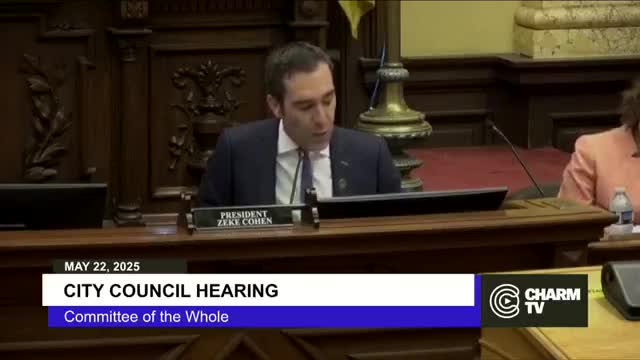
Summary
At a May 22 Committee of the Whole hearing, Baltimore budget officials and council members said hundreds of long-unfilled positions and rising overtime—especially in police and fire—are creating budget gaps that may require supplemental appropriations and complicate truth-in-budgeting efforts.
Baltimore City Council’s Committee of the Whole heard testimony May 22 on growing overtime costs and thousands of vacant positions across city agencies, with council members and the administration warning the two problems are linked and could force late-year supplemental budget requests.
The discussion matters because the council and administration must finalize the fiscal 2026 budget in coming weeks. Council members said budgeting for positions that remain unfilled inflates appropriations on paper while agencies then reallocate those dollars to overtime, contractors or other expenses without prior council approval.
Council President (name not specified) opened the hearing and summarized the council’s analysis, saying the city has been “budgeting for hundreds of positions that have been vacant for at least 18 months” and calling those “phantom positions” because “they exist on paper but are apparently unlikely to be filled by real people.” Laura Larson, the city’s budget director, told the committee the administration’s Workday-based dataset shows general fund overtime hours rose between calendar years 2023 and 2024 and that a small number of agencies account for the vast majority of overtime.
Larson said the dataset shows “general fund overtime was up by about 15.9%,” and she identified six agencies that together account for roughly 95% of the city’s overtime utilization; the police, fire and public works departments are the largest contributors. Larson also told council members that as of May the city had about 2,736 vacant positions across all funds, roughly 1,600 of which are funded by the general fund, and that 554 general-fund positions had been vacant longer than 18 months. Larson said roughly half of those long-term vacancies are concentrated in police and fire and that much of the budgeted salary savings for long-vacant posts has effectively been redirected to overtime in those departments.
Council members pressed for specifics and follow-ups. Councilman Ryan Dorsey said the pattern leaves the council “essentially forced to approve supplemental appropriations” after agencies exceed their budgets; he asked what fiscal controls prevent agencies from overspending. Larson said Workday implementation initially decentralized some budget checks and that her office has been reintroducing stronger central reviews and quarterly monitoring to flag agencies trending over budget earlier in the year.
Councilwoman McCrae and others cited the administration’s overtime figures for agencies reporting directly to the administration: about $114,000,000 in overtime from the general fund in calendar year 2023 and about $139,000,000 in calendar year 2024. Larson said the fiscal 2026 budget includes $89,500,000 budgeted for overtime across all funds, with $68,400,000 of that in the general fund, and that the administration expects to bring supplemental requests to the Board of Estimates and council to reconcile fiscal 2025 deficits identified in third-quarter projections.
On hiring and human resources, interim Department of Human Resources Director Tanya Brinkley said Workday fields needed for tracking the hiring pipeline were enabled in March and agencies were trained to use them: “As of March, those have been turned on, and the agencies have been trained on that so that when they're going through the process, they can no longer skip those actions.” Brinkley said reliable reporting on time-to-hire will take several months of data and estimated about six months to produce a useful trend report.
Council members requested multiple follow-up items and data sets. Committee requests recorded in the hearing include: median overtime (hours and dollars) by classification for police and fire; turnover rates and exit-interview analysis for the fire department (with a one-week target to provide existing exit-interview content); the dollar value of long-term vacant positions and the portion of budgeted salary savings that agencies reallocated to overtime; the administration’s supplemental appropriation sizing and timing; and a study to examine correlations between overtime, sick leave usage and turnover in the city’s largest service agencies (police, fire, Department of Public Works, Department of Transportation and Recreation & Parks).
Council members and administration witnesses repeatedly drew a distinction between discussion and formal action: the hearing produced no votes or budget decisions. Larson and Brinkley pledged to provide the requested follow-up data and to continue working with agency leaders to reduce vacancy-driven overtime; Larson said the administration’s fiscal 2026 proposals include steps intended to reduce overtime in fire and police through recruitment, civilianization and use of dedicated grant funds for contractual EMS where appropriate.
The hearing produced detailed quantitative clarifications from administration staff—about vacancy counts, overtime dollar and hour totals, and the mechanics of how agencies have been using vacancy savings to meet daily minimum staffing requirements—but no new ordinances or budget amendments were adopted during the session. The committee closed with the expectation that the administration will return supplemental figures and the specified datasets before the council’s final budget action so the council can weigh those numbers in FY26 negotiations.
Ending: The hearing framed vacancies and overtime as linked operational and budget-management problems: council members framed the issue as a truth-in-budgeting concern that should be resolved before finalizing FY26 appropriations, and the administration agreed to supply data and additional controls to help the council evaluate tradeoffs in the coming weeks.