
Fairfax to begin town‑center parking inventory and community outreach; council declines immediate paid‑parking study
Get AI-powered insights, summaries, and transcripts
Subscribe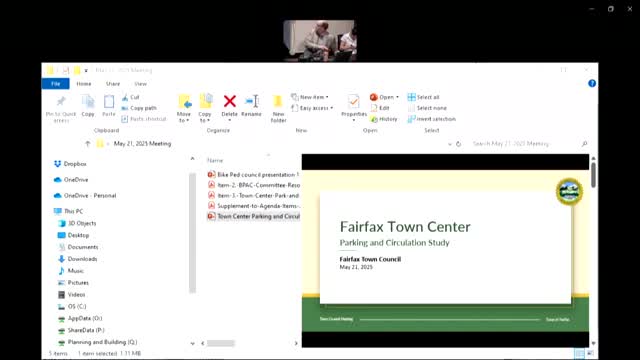
Summary
Fairfax will begin a staff‑led inventory of downtown parking spaces and merchant outreach rather than immediately commissioning a larger consultant circulation study; council asked staff to report back with a baseline and recommended next steps.
The Fairfax Town Council directed staff to start a town‑center parking inventory and outreach to downtown merchants and residents, rather than immediately commissioning a full parking‑and‑circulation engineering study. Planning staff presented a menu of options — from a low‑cost inventory using staff and volunteers to a full traffic and circulation analysis that could run tens of thousands of dollars — and recommended starting with a baseline inventory and public outreach.
Why it matters: council members and downtown stakeholders noted competing priorities: visible sidewalks, pedestrian safety and immediate merchant needs versus a larger, consultant‑led circulation study that would model intersection operations and parking utilization. Staff emphasized that the 2012 parking inventory is out of date and that a contemporary baseline will inform whether further technical analysis is needed and whether targeted proposals such as a parking benefit district, paid parking or managed lots are warranted.
What staff proposed: a phased approach. Stage 1 — a low‑cost inventory and merchant/resident outreach to establish current supply and demand and capture local user experience. Stage 2 — if needed, a manager‑recommended study of parking management options (time limits, paid parking, permits, parking benefit district) and a full circulation analysis to identify bottlenecks and safety interventions. Staff suggested the parking inventory could be completed using in‑house time with merchant participation and volunteer support and return to council with a short “white paper” of findings and options.
Public comment was sharply divided. Some merchants and residents opposed paid on‑street parking meters and said parklets and existing uses are important to downtown vibrancy; others urged a more ambitious inventory and called for consideration of a parking benefit district to reinvest parking revenue locally and to fund sidewalks, lighting and other improvements. Several speakers urged quicker action to help merchants and to preserve downtown parking for customers.
Council direction and next steps: the council supported a staff‑led baseline inventory and community engagement (staff to work with merchants and residents; potential for volunteer days or merchant walks) and asked staff to report progress in coming months. Several members noted limited staff bandwidth and suggested the work be phased; staff said they would report back with a schedule and that a more in‑depth consultant study could be brought forward for funding consideration later.
Ending: the consensus decision directed staff to begin a practical, low‑cost inventory and outreach and return with a written summary of findings and recommended next steps. Any decision to pursue paid parking, meters or a full circulation study would be a later policy decision by the council and could require additional funding.