
Fairfax council approves first reading of ordinance to restrict throttle e-bikes for riders under 16, adds helmet and education provisions
Get AI-powered insights, summaries, and transcripts
Subscribe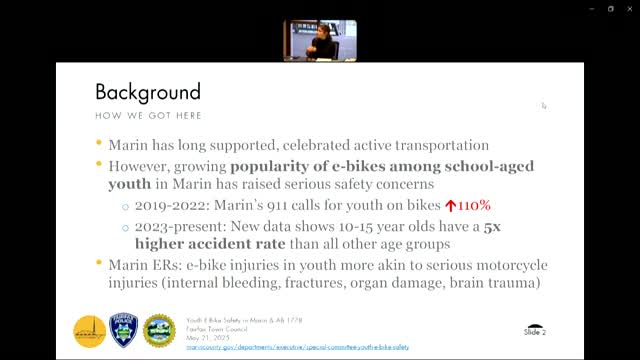
Summary
After a county presentation on youth e‑bike injuries, the Fairfax Town Council voted to introduce—by title only—an ordinance aligned with Marin County’s pilot program to treat throttle (class 2) e‑bikes like higher‑speed models, require helmets for those devices and pair the rule with a public education program.
Fairfax Town Council introduced, on first reading and by title only, an ordinance to add local rules for electric and “micro‑mobility” devices that would treat class 2 throttle e‑bikes more like higher‑speed electric bicycles and restrict them to riders 16 and older, require helmets for those devices and rely mainly on education and secondary enforcement.
County staffer Talia Smith told the council the county’s data show a marked increase in serious injuries involving youth on certain e‑bikes. “When it comes to e‑bikes, that youth age group 10 to 15 have a 5 times higher accident rate than other age groups,” Smith said, summarizing Marin County tracking that began in 2023.
The nut graf: the ordinance uses authority granted by Assembly Bill 1778, a state law that created a Marin County pilot allowing jurisdictions to opt in and apply stricter age and helmet rules to class 2 (throttle) e‑bikes. Supporters said pairing regulation with a coordinated public education campaign and school outreach is essential; several council members and speakers emphasized the limits of local authority and the need for consistent countywide implementation to avoid a patchwork of rules.
Most important facts: the ordinance would apply the same minimum age (16) and helmet requirements now required of higher‑speed class 3 e‑bikes to class 2 throttle e‑bikes in jurisdictions that opt in to the Marin pilot. County staff described a planned safety campaign with schools, Safe Routes to Schools and law enforcement; staff said enforcement will generally be secondary and that many cases would be routed first to an educational diversion program. Marin’s public‑health and EMS partners said conventional bicycle calls rose modestly, but calls tied to e‑bikes show a much larger increase in injuries to younger riders, including severe trauma similar to motor vehicle crashes.
Council discussion touched on enforcement, penalties and equity. Council member Koehler asked whether fines would be a real deterrent for owners of expensive e‑bikes; staff answered that the municipal fine structure is constrained by state vehicle code and that most enforcement is expected to be educational or secondary. Council members also pressed on tandem riding, bike tampering (speed modification), whether retailers would be required to give buyers standardized safety information, and how the ordinance would treat people who use mobility devices covered by the Americans with Disabilities Act. The ordinance draft explicitly exempts ADA‑covered mobility devices (wheelchairs and similar power‑driven assistive devices).
Public comment ranged from parents and school advocates urging action and strong education to an advocate for people with disabilities who urged the council not to use language that could be read to restrict wheelchairs or other assistive devices. Staff and county presenters repeatedly said the draft has explicit ADA exemptions and that switching the title language to “electric mobility (micro‑mobility) device” was intended to make clear the ordinance targets scooters, e‑bikes and similar recreational/transport modes rather than assistive devices.
Action: the council voted to introduce the ordinance (first reading by title only) and to proceed with the draft language that inserts “micro‑mobility” in the ordinance text for clarity. The council also heard that the county and cities in Marin plan a coordinated implementation and public‑education timeline for this summer and school reopenings.
What’s next: the council’s action was a procedural first reading; staff said they will coordinate locally on targeted outreach to parents and schools and finalize implementation details, including how diversion education will be administered in partnership with Mill Valley’s program. County staff and the council noted pending and recent state bills aimed at making illegal the tampering of e‑bike speed limits and closing product‑safety gaps at the federal level.
Ending: the council’s vote sends the ordinance forward for a second reading and adoption process. If adopted, Fairfax’s rules would mirror the Marin pilot and join neighboring jurisdictions that are moving to the same countywide approach this year.