
Seattle School Board reviews interim guardrail metrics for safety, equity, engagement and resources
Get AI-powered insights, summaries, and transcripts
Subscribe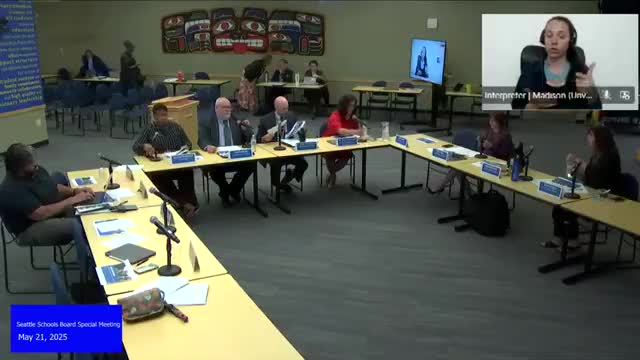
Summary
Seattle School District staff and board members spent the second half of a May 21 special meeting reviewing draft interim metrics tied to the board’s five guardrails — the nonnegotiable conditions staff must not violate when pursuing the district’s strategic goals.
Seattle School District staff and board members spent the second half of a May 21 special meeting reviewing draft interim metrics tied to the board’s five guardrails — the nonnegotiable conditions staff must not violate when pursuing the district’s strategic goals.
Chief Operating Officer Fred Podesta and Associate Superintendent Dr. Rocky Torres Morales led the discussion of metrics staff propose to monitor progress on guardrails that cover physical and emotional safety, adult behaviors aligned with antiracist values, meaningful engagement, equitable academic access, and alignment of resources to student needs.
Why it matters: The board adopted goals and guardrails to focus district decision‑making. Interim metrics are intended to give the board measurable indicators to track whether district operations remain inside those guardrails while staff make tactical choices. Directors said the metrics must be practical, verifiable, and useful for course corrections.
Key proposals and board feedback
- Guardrail 2 (Physical and emotional safety). Staff proposed using student climate survey measures of perceived safety as a leading indicator and school‑level preparedness exercises (drills and training participation) as observable measures. Dr. Torres Morales said staff intend both quantitative survey items and counts of preparedness activities; Podesta acknowledged current under‑reporting of incident data and said the district will work to improve incident reporting before using that as a baseline metric. Director Rankin and others urged metrics that drive improved reporting and response, not just perception scores.
- Guardrail 3 (Adult behavior and antiracist practices). Staff proposed four foundational measures: completion of antiracism professional learning by staff, measures of staff confidence to implement antiracist practices, student perceptions that staff respond to race/equity issues, and student perception of curriculum representativeness. Directors pressed for measures that go beyond completion checkboxes to track whether training changes adult behavior and produces different outcomes for students. Several directors suggested tracking outcomes such as discipline disproportionality, restorative practice fidelity or resolution satisfaction for reported incidents.
- Guardrail 4 (Engagement). Staff proposed interim metrics that include the percentage of central‑office and school leaders who complete training in effective engagement practices, a measure of family/staff perception that they had a meaningful opportunity to inform major decisions, and improved documentation in board action reports showing how community input influenced final decisions. Directors recommended clearer, audience‑appropriate engagement toolkits, stronger tracking of issue resolution (not just intake), and a public measure of how often matters brought to public testimony were previously unresolved by other channels.
- Guardrail 1 (Academic access) and Guardrail 5 (Resource alignment). For academic access, staff proposed (1) a family survey item about whether the school provides a high‑quality education that meets their child’s needs, (2) availability of advanced course offerings across secondary schools, and (3) the share of elementary schools classified as "foundational" under the state accountability system (staff explained that in Washington the lowest 5% of schools receive targeted supports while "foundational" schools do not require state intervention). For resource alignment, staff proposed metrics such as percent of general fund spent on teaching and teaching support (staff cited an initial target of more than 70% for 2025–26) and a school‑level floor for annually allocated funding.
Board guidance and process notes
Directors repeatedly requested more precise, actionable definitions and cautioned against early use of imperfect incident or climate data that could create perverse incentives (for example, under‑reporting). Several directors recommended adding follow‑up or “close‑out” surveys for people who used complaint or civil‑rights channels to measure satisfaction with resolution. Multiple board members urged staff to develop a shared, plain‑language explanation of what each guardrail means in practice, and to pilot the progress‑monitoring calendar that staff described for regular (monthly or quarterly) feedback rather than a single annual review.
Staff next steps
Staff said they will refine the interim metrics based on board feedback, increase efforts to improve the completeness of incident reporting, and continue work on a progress‑monitoring calendar that brings timely, disaggregated data to the board for course correction. Staff also said selection for a strategic‑plan task force is underway and that more detailed resource‑and‑strategy analysis (with ERS consulting) will feed future metric refinement.
Ending note
Board members agreed to continue developing and practicing progress monitoring, with staff to return refined metric drafts and supporting definitions. Directors emphasized they want metrics that are evidence‑based, actionable, and tied to clear processes for school‑level follow‑up and community feedback.