
Seattle Public Schools previews 2025–26 budget, cites $100M structural gap and new state levy authority
Get AI-powered insights, summaries, and transcripts
Subscribe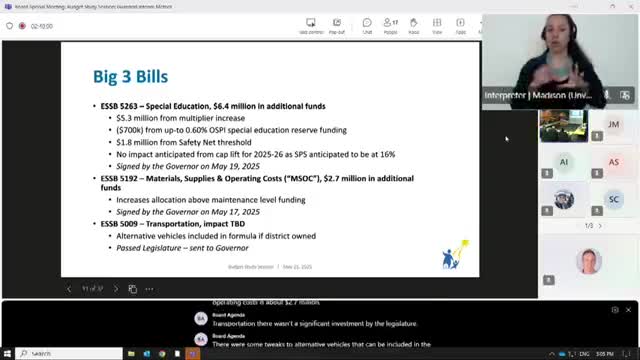
Summary
At a May 21 special meeting, the Seattle Public Schools Board of Directors heard a staff preview of the district’s proposed 2025–26 budget and options to close an estimated $100 million structural shortfall.
At a May 21 special meeting, the Seattle Public Schools Board of Directors heard a staff preview of the district’s proposed 2025–26 budget and options to close an estimated $100 million structural shortfall.
Chief Operating Officer Fred Podesta and Assistant Superintendent for Finance Dr. Kurt Buttleman told the board the district projects a deficit ‘‘in the ballpark of $100 to $104 million’’ for 2025–26 and is proposing a package of one‑time and on‑going adjustments to balance next year’s books while limiting changes to school programs.
The staff presentation said the Legislature passed ESHB 2049, which increases local levy collection authority by $500 per student; Buttleman said that change adds about $13 million to the 2025–26 budget and will yield roughly an additional $23–24 million once collections are fully phased in. Staff also said the Legislature extended the payback period for interfund loans from two years to four years, a change the district plans to use in its proposal to delay some capital‑fund repayments.
Why it matters: Seattle Public Schools faces a multi‑year structural funding gap driven primarily by staffing costs and enrollment declines. Staff said the 2025–26 proposal aims to preserve current program offerings and avoid district‑wide school closures or large, immediate staffing reallocations while a longerterm resource and strategy study runs.
Most significant details
- Structural shortfall. Staff repeatedly described the district’s long‑term problem as structural: revenues from state funding and local sources do not fully cover recurring expenditures. Buttleman said the district has reduced the headline deficit from earlier years but still faces a near‑term shortfall of about $100–104 million.
- How staff propose to close the gap. The previewed package combines delayed capital fund repayment, one‑time use of unrestricted reserves, extending part of an interfund loan, selected central‑office reductions, and new local levy capacity from the Legislature. Specifically, staff said the district would repay up to $17.6 million of a prior $27.5 million capital loan in 2025–26 and continue roughly $11 million of loan carryforward into the next fiscal year.
- Central office reductions. The presentation listed approximately $5.4 million of proposed reductions in central office budgets, largely from vacant or eliminated positions (about $3.5 million), building consolidation of underused spaces to reduce utilities and maintenance costs, and savings in contracted services and other operating items.
- Federal funding uncertainty. Chief Redmond said federal funds make up roughly 6.5% of the district’s revenue and cover Title I, special education, school food services and Head Start. District staff have convened a federal response team to monitor executive orders and federal policy changes; Redmond said the Office of the Superintendent of Public Instruction had not yet indicated immediate changes, but the district is preparing contingency planning. Staff said there is no ready‑made backup plan if a large portion of federal funding were cut overnight; instead, the district would evaluate restricted and committed funds and consider program adjustments.
- Legislative and levy impacts. Staff noted some bills affecting K–12 were signed by the governor late in the session. In addition to ESHB 2049’s levy authority increase, the district received a one‑time $50 per‑student allocation for 2024–25. Board and staff said the recent levy and legislative changes reduce, but do not eliminate, the district’s structural gap.
Board and public context
Board members pressed staff on timing and whether the district could make changes now that would affect building‑level budgets. Director Rankin and others said community engagement in February felt too late to influence building budgets that were already being prepared. Staff acknowledged the timing constraints and said changing the sequence of budget milestones would require process reengineering but is under discussion; they noted some late adjustments made in response to enrollment and program decisions have been possible in recent cycles.
Multiple directors urged staff to provide clearer, audience‑appropriate budget materials for both board oversight and public engagement, and to create a feedback loop so community participants can see how their input was used. Rankin described repeated frustration that the board had directed long‑term planning in 2023 but still sees similar budget slides without substantive progress.
Next steps and schedule
Staff posted the full budget book on the district website the night before the meeting. The district’s formal public hearing on the budget is scheduled for June 4, followed by a board vote on July 1. Podesta and Buttleman said the district expects to continue the resource and strategy work that will inform later years’ budgets and the strategic plan task force selection process planned for early June.
Ending note
Staff framed the 2025–26 proposal as a transitional step intended to preserve near‑term stability for schools while the district pursues a longer‑range plan to address structural funding issues. As several directors noted, that approach postpones larger policy choices the board and district will need to make to close the multi‑year deficit.