
Clark County fiscal court debates FY2026 budget, EMS and 911 funding amid carryover concerns
Get AI-powered insights, summaries, and transcripts
Subscribe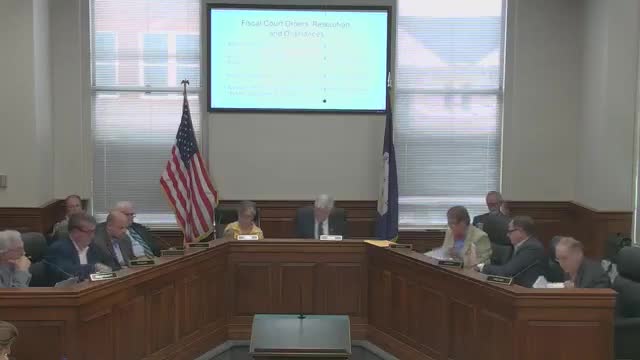
Summary
Magistrates and staff debated the proposed FY2026 budget, questioned receipt and carryover estimates, and discussed provisional EMS and 911 funding levels; the court scheduled a special meeting to refine appropriations and requested additional revenue and expense detail from staff.
Clark County magistrates and staff spent much of the meeting scrutinizing the proposed fiscal year 2026 budget, focusing on optimistic revenue estimates, the county's carryover, and large service agreements for EMS and 911.
Finance staff presented the draft first-reading budget and the court discussed whether projected carryover and certain revenue lines were overstated. One magistrate reviewed receipts and argued the proposed carryover was inflated compared with actual cash-on-hand and anticipated near-term expenses, saying that if projected receipts did not materialize the county could be placed "in the hole." The finance director provided a conservative and a comfortable carryover estimate: "Comfortably, I would say 6. Conservatively, 4" (carryover in hundreds of thousands, per finance director's comment in context).
EMS and 911 funding dominated discussion. The court sought a clearer, early exchange with the city and the EMS operational board about planned equipment purchases and ongoing contribution expectations. Members proposed and informally agreed on budgeting a provisional county EMS contribution of $650,000 for planning purposes and discussed an increase in 911 appropriations tied to anticipated new revenue, noting that any final number would depend on the city's budget and the committee discussions.
Judge Yates and several magistrates urged tighter spending control and suggested revising appropriation lines rather than rely on inflated revenue projections. Several members proposed reworking the budget to base line-item appropriations on the prior year's approved budget (then add payroll/insurance changes), and to use budget amendments later if additional revenue becomes available.
The court scheduled a special meeting to revise the budget and directed staff to produce a revised packet with clarified receipts and assumptions. Members agreed to hold a follow-up special meeting (noted in the meeting as Thursday, May 29 at 5:30 p.m.) to allow departments time to revise appropriation requests and to give the court updated numbers before the final readings.
Why it matters: The fiscal court is operating with constrained cash balances and recurring years when appropriations exceeded receipts; members signaled they want to avoid repeating prior-year shortfalls by aligning appropriations more closely with verifiable revenue.
What happens next: Staff will rework revenue and appropriation assumptions, departments were asked to revisit requested line items, and court leaders planned targeted committee meetings (EMS committee, budget review) to align expectations. The court also discussed longer-term revenue options, including an increase in the insurance-premium tax, and emphasized the need for a measurable plan to track turnover, recruitment, and the effect of proposed compensation changes on staffing costs.