
Hamilton County commissioners approve funding request for Little Miami anaerobic digester as residents raise PFAS concerns
Get AI-powered insights, summaries, and transcripts
Subscribe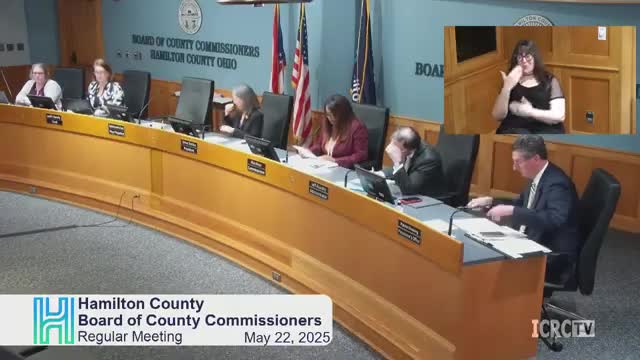
Summary
The Board approved MSD—s funding request for upgrades at the Little Miami wastewater treatment plant, including an anaerobic digester and odor control, while public commenters and environmental groups urged testing for PFAS and other contaminants in biosolids before land application.
The Hamilton County Board of Commissioners voted to approve Metropolitan Sewer District (MSD) funding for the Little Miami wastewater treatment plant solids-disposal and odor-control project, which includes installing an anaerobic digester to convert solids into biogas and biosolids.
The approval clears a request to appropriate an additional $67,898,112 for the main work package of the project, which MSD officials said will reduce truck hauling and landfill disposal, generate on-site renewable energy, and improve odor controls. The project had three earlier early-work packages already authorized.
Supporters, including MSD staff, told the board the digester will reduce pathogen levels and overall solids volume. Lauren DeGresia, representing MSD, said the digester will allow the plant to reuse biogas on site to run plant operations and reduce reliance on the electric grid.
Environmental commenters told the board they support reducing landfill disposal but urged caution about the resulting biosolids. Larry Falcon told commissioners the project would keep sewage sludge out of landfills and produce renewable energy, but he said, “there is a growing awareness that the biosolids contain high levels of contaminants that are very resistant to most treatment technologies.” He asked the district and county to test sludge for PFAS and other persistent contaminants before approving land application.
Marilyn Wall, speaking for Circle V (as identified on the record), likewise urged testing and said scientific literature shows biosolids can contain pharmaceuticals and industrial toxics that are not destroyed by anaerobic digesters. She said, “Land application of biosolids may become a liability to city and the county,” and recommended managing materials so they cannot discharge to people or waterways.
MSD deputy director Ryan Welsh acknowledged the concerns and told the board the district will monitor incoming waste streams and solids composition over the next two to three years before deciding on long-term disposal pathways. "We don't have any reason to think right now that we have elevated levels in the solids," Welsh said, and added MSD will follow applicable regulations and monitoring as disposal options are evaluated.
Commissioners asked questions and then approved regular agenda items 3 and 4, which included the Little Miami project. The motion to approve carried with Commissioners Driehaus and Reese recorded as voting yes.
The district said the upgrades are intended to reduce greenhouse gas emissions, cut disposal volume, and improve odor control; MSD also noted the eventual disposal approach for biosolids will be decided after monitoring and in line with regulatory guidance.
The board received written comments from members of the public and the Sierra Club urging robust chemical testing, and MSD told the commissioners it will keep sampling and follow EPA and state guidance as the project moves to construction and operational phases.
MSD told the board this appropriation is anticipated to be the final funding request for the main contract; commissioners approved the funding during the May 20 meeting and asked staff to continue engagement with community commenters about monitoring and disposal decisions.