
Lake Stevens planners map housing response as state law expands emergency, transitional and supportive housing rules
Get AI-powered insights, summaries, and transcripts
Subscribe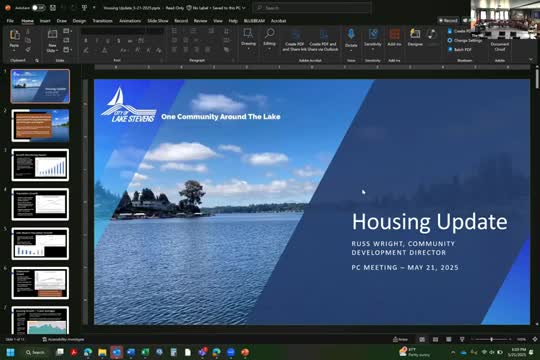
Summary
Lake Stevens city staff told the planning commission on May 20 they will draft municipal code changes to implement state requirements that expand where emergency, transitional and permanent supportive housing may be allowed, as local housing demand and rents increase.
Lake Stevens city staff told the planning commission on May 20 that the city is preparing code changes to implement state rules that require municipalities to allow emergency, transitional and permanent supportive housing in many zones while the community faces rising housing demand and prices.
"Since housing was the number 1 priority for the planning commission as we set our work plans for the year, I just wanted to make sure that you're receiving some of that same sort of regional information and then trying to put it in a city context," Russ Wright, Community Development Director for the city of Lake Stevens, said as he opened a regional housing report for the commission.
The report summarized county and local trends that staff said explain why the new state requirements matter locally: Snohomish County’s population was nearly 830,000 at the 2020 census and the county is roughly on its projected growth track; Lake Stevens added about 2,600 people between 2020 and 2024, roughly a 6% increase; and single‑family construction has declined while apartment starts and attached housing have risen. Countywide median home prices are around $822,000 and county average rent was cited at about $2,100 per month; Lake Stevens’ average rent was reported at roughly $1,700 per month.
"House Bill 12 20 required local jurisdictions to allow, or I think the term is not prohibit, emergency housing in any zone where hotels are allowed," David Levittau, Senior Planner, told the commission in a later presentation on code updates. Levittau said the statute also requires jurisdictions to allow transitional and permanent supportive housing in a much broader set of zones — including areas that allow single‑family and multifamily housing — and to treat those housing types more like standard residential units.
Under staff’s reading of the law and guidance from the Washington State Department of Commerce, cities may still adopt objective limits tied to public health and safety — for example occupancy, spacing and intensity rules — but must demonstrate a clear nexus between those limits and the impacts being addressed and must avoid rules that make it impossible to meet state growth targets.
Staff showed three local examples for how other cities have implemented step‑housing rules: Edmonds, which largely treats step housing as an outright permitted use with limited extra local requirements; Redmond, which adopted a prescriptive approach including an approximately one‑half‑mile buffer between certain supportive housing projects and multiple required operations plans; and Lynnwood, which staff described as a middle approach that requires an application narrative addressing operations, parking and safety but not a stack of separate, specified plans.
Commissioners debated the balance between easing barriers to development and protecting neighborhoods. "Once it's here, it's here," Commissioner Packard said, arguing for caution on the scope and location of new uses. Commissioner Jennifer Davis said the commission should avoid creating barriers that make projects impossible while preserving neighborhood protections: "we should not be creating artificially high barriers to this." Commissioner Dewar urged respect and an approach that balances community needs and protections.
Staff told the commission that the city’s land capacity analysis already shows Lake Stevens has zoning capacity to meet the state’s targets for emergency and supportive housing and that the next step is to add definitions and update permissible‑use tables and supplementary use regulations in Lake Stevens’ municipal code. Levittau said the work will include drafting new definitions, updating chapter 14.40 (permissible uses), and adding supplementary use regulations similar to those the city already has for accessory dwelling units, short‑term rentals and temporary encampments.
No ordinance or regulatory language was adopted at the meeting; commissioners provided general policy direction and asked staff to return with draft code language and comparative examples for public engagement. Staff noted the state’s deadline for development regulations tied to the 2024 periodic update was moved and that the city is working toward meeting the updated schedule.
The planning commission and staff said they will continue public outreach and bring draft code back for additional review before any formal council action. The commission’s next meeting was scheduled for Monday, June 2, 2025.