
St. George council approves 700 East multimodal project after divided debate
Get AI-powered insights, summaries, and transcripts
Subscribe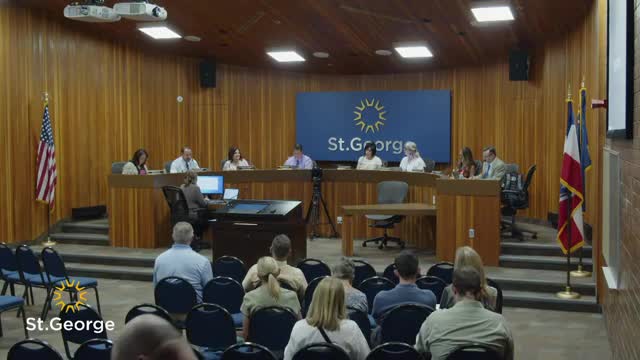
Summary
The St. George City Council voted 3–2 to approve design and funding acceptance for a multimodal cycle track and pedestrian improvements on 700 East, prompting debate about lost on-street parking and traffic impacts near Utah Tech University.
The St. George City Council voted 3–2 to approve item A on the consent calendar, advancing a proposed multimodal project on 700 East that adds a cycle track, bulb outs and landscape medians intended to improve pedestrian and bicycle safety.
The project, developed in coordination with the university and UDOT, is intended to “provide all users with transportation choices,” according to a city staff presentation that quoted a UDOT representative describing the plan as an urban trail connecting upper and lower trail systems and creating a “traffic calming measure.” The council discussion focused on pedestrian safety, parking loss on the east side of 700 East and potential traffic displacement onto nearby residential streets.
Proponents, including a council member who said the university “has ample parking,” said the changes will shorten crossing distances, reduce conflict areas and make access to Utah Tech University safer by encouraging walking, biking and transit. Opponents said the project will remove on-street parking used by university visitors and push cars onto neighborhood streets, raising concerns about elderly funeral attendees walking longer distances near the cemetery and potential congestion from a planned underpass on 400 East.
Council members also discussed project costs already incurred: staff said design work on the project has cost “almost $28,000,” and an earlier avenue study likely cost in the “$25,000–$35,000 range.” Staff warned that returning grant funds would require paperwork and could carry practical and political hurdles.
After discussion the council voted to approve the consent item. The motion to approve item A was moved by Danielle Larkin and seconded by Michelle Tanner (as recorded during the meeting). The motion passed 3 to 2.
Council members asked staff to track the practical effects of the change, including where displaced parking will migrate and how pedestrian volumes are affected once construction is complete. The city noted the university has agreed to maintain some landscaping in the median, reducing the city’s maintenance burden.