
Pitt County planning board hears presentation on proposed mega site on Weyerhaeuser land
Get AI-powered insights, summaries, and transcripts
Subscribe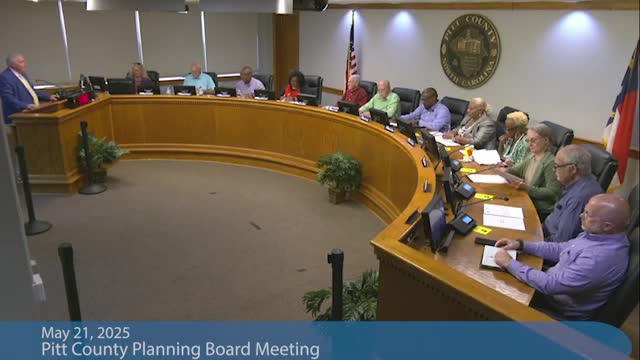
Summary
The Pitt County Planning Board received an informational briefing on a proposed “mega site” that would study 3,300 acres of Weyerhaeuser‑owned land to determine whether a contiguous 1,000‑acre industrial pad could be developed, board members were told.
The Pitt County Planning Board received an informational briefing on a proposed “mega site” that would study 3,300 acres of Weyerhaeuser‑owned land to determine whether a contiguous 1,000‑acre industrial pad could be developed, board members were told.
Josh Lewis, president and CEO of the Eastern North Carolina Alliance, said the state selected a small number of North Carolina sites for a mega‑site readiness program that provides major state funding for site acquisition, due diligence and infrastructure. “Pitt County, based on a developable opportunity, is probably the best opportunity that the state has to invest dollars and get a site up and viable in a short amount of time,” Lewis said.
The briefing explained why the property is under consideration and what would be required for the site to advance. County planning staff told the board that the property owner, Weyerhaeuser, submitted a rezoning application; staff received that application “yesterday” and the item will be advertised and go through a public‑hearing process at the board’s June meeting. Jonas Hill, planning staff, said the county’s zoning ordinance requires notice to property owners within 500 feet but staff will send notices to about 1,000 feet for this request; he reported preliminary outreach will go to roughly 317 property owners, signs will be posted on the site and the request will be publicized in the Daily Reflector.
Board members and staff described the basic site parameters discussed in the presentation: a 3,300‑acre study area, a requirement that a qualifying “mega site” include at least 1,000 contiguous acres, and the goal of identifying a pad and locating utilities and road access. Lewis outlined the parties involved in the state selection process and the consultant team (JLL and Timmons Group, with a third‑party partner called Nexen Pruwit in the presentation) that evaluated candidate properties statewide. He said the consultant produced order‑of‑magnitude cost estimates for due diligence and infrastructure and found the Pitt County location comparatively less expensive because of utility capacity and landowner control.
Lewis described the funding structure discussed in the presentation: the state prepared an initial pool to allow sites to complete due diligence and engineering, noting $10,000,000 was put “in the pot” for due diligence and that roughly $100,000,000 currently sits in a site‑development fund; he said, however, that bringing a site to full readiness can require “hundreds of millions” more and that local matching commitments would be required if a site is selected. Lewis also said the mega‑site program expects to invest state general fund dollars rather than federal grants; he added that decisions on disbursing state funds are made by the Economic Development Partnership of North Carolina (EDPNC) and the North Carolina Department of Commerce.
Board members pressed staff and Lewis on likely local impacts and on transportation access. The concept shown to the board included a 4‑lane access road off Highway 11 and a proposal to end or reconfigure Saintsville Road where it crosses the conceptual pad. Staff said the city recently agreed to run sewer to the site without annexation and that the Greenville Utilities Commission (GUC) voted to extend sewer on its side; those actions are complete steps required before rezoning and funding applications. Staff emphasized that any detailed site or subdivision plan would be coordinated with NCDOT and that heavy industrial traffic would be expected to use the planned 4‑lane access rather than neighborhood roads.
The application package submitted with the rezoning request includes a proposed text amendment to the county ordinance to create a perimeter conservation buffer; staff said the proposed buffer has been discussed at public information sessions and in the application materials and that the proposed text would prevent development of the buffer for building pads. Lewis said the team aims to minimize impacts to nearby residents by using conservation zones and carefully siting access points.
Board members and staff reviewed a rough schedule described by Lewis: local option agreements for control of the land would likely be for a multi‑year period (Lewis described a probable 3‑ to 5‑year option agreement), with a couple of years anticipated for due diligence and major utility studies before seeking larger infrastructure funding from the state. Lewis described expected economic outcomes using national mega‑site averages — large projects can produce billions in private investment and generate substantial tax revenues — but he and staff cautioned the board that those were “average” profiles and that any single project’s scale would vary.
After discussion, the board voted to hold a staff‑guided field trip to the site on June 16 at 2:00 p.m. to allow members to view the parcel and the surrounding neighborhoods; staff said they would coordinate transportation and would make arrangements for any members who could not attend the group trip to visit on their own. Jonas Hill said staff will continue to accept questions and provide materials via the project’s public website and through scheduled public information sessions.
What happens next: staff will process the rezoning application, publish legally required notices, and present the rezoning request and any proposed text amendment at the board’s public hearing in June. If the board and the county decide to pursue state mega‑site funding, the application for state funds would follow the local steps outlined by staff and the EDPNC/Department of Commerce review process.