
Tarrant County public hearing draws starkly divided comments over proposed redistricting maps
Get AI-powered insights, summaries, and transcripts
Subscribe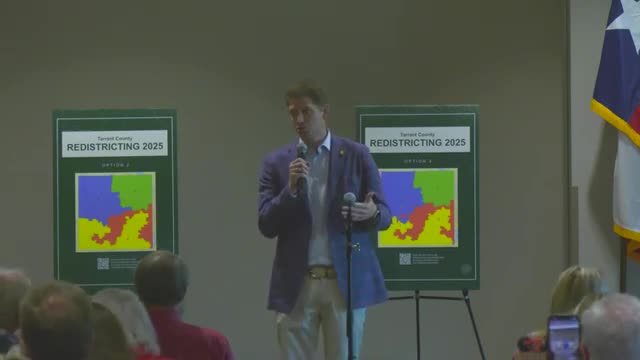
Summary
TARRANT COUNTY — At a public hearing on proposed changes to Tarrant County commissioner precinct boundaries, Commissioner Matt Krause said he and other members of the court are pursuing mid‑decade redistricting and made clear his partisan aim.
TARRANT COUNTY — At a public hearing on proposed changes to Tarrant County commissioner precinct boundaries, Commissioner Matt Krause said he and other members of the court are pursuing mid‑decade redistricting and made clear his partisan aim.
“My entire purpose, my entire intention is to allow Tarrant County to go from 3 Republicans, 2 Democrats on the commissioner's court to 4 Republicans, 1 Democrat,” Commissioner Matt Krause said at the start of the meeting.
The meeting at the Gary Fickas Northeast Courthouse was organized to gather public comment on five draft maps prepared under an agreement the commission approved April 2, 2025 with the Public Interest Legal Foundation (PILF). Mike Garcia, a precinct staffer who reviewed ground rules, told attendees where to find the maps and how to submit written comments.
Why it matters: The five draft plans would redraw how the county’s voting population is divided among four commissioner precincts ahead of the 2026 primary and general elections. Supporters said the maps reflect population growth and will preserve conservative leadership that, they said, has reduced property taxes and prioritized fiscal restraint. Opponents said the draft maps concentrate voters of color into a single precinct — a strategy known as “packing” — and divide other communities, an effect they say could violate Section 2 of the Voting Rights Act and invite expensive litigation.
What speakers said: Joshua Moore, speaking on behalf of Representative Nate Chatson as his district director, read a statement saying, “This process is not racial gerrymandering” and endorsed map 1 as the plan that “provides the strongest conservative representation for Tarrant County.” Several other speakers, including residents who identified as longtime county residents or local elected officials, voiced support for map 1 and for moving forward now rather than waiting until after the 2030 census.
Opponents pushed back with demographic claims and legal warnings. Carla Gonzales cited 2020 census–based figures presented at the hearing, saying, “Tarrant County is made up of 57% black, brown, and Asian community members per the 2020 census,” and that in the proposed map 1 Precinct 1’s share of residents of color would rise from about 66% to about 78%, which she described as “packing the precinct.” Kevin Patrick and other speakers warned of potential lawsuits and cited Galveston County’s ongoing litigation costs as a cautionary example; Patrick said Galveston has spent at least $4,000,000 defending a commission mapping dispute.
Several speakers who opposed the plans described the process as rushed and questioned the need for mid‑decade redistricting. Allison Campolo, who said she had reviewed election data at multiple hearings, told the court, “The current map is already balanced. We want no new maps,” and argued that the precincts were close to parity under the 2020 census. Other speakers said the county previously reviewed precinct lines in 2021 and decided not to redraw them because deviations were small (they cited figures under 2 percent in that review).
Scope and procedure: County staff said the five draft options are based on 2020 census data and noted that handouts and digital copies of the maps are available at www.tarrantcountytx.gov/redistricting. The hearing provided three minutes per speaker and accepted written comments through the county website and QR code displays. No vote or formal action on any map took place at the hearing; the session was a public comment opportunity.
Disagreements centered on two linked factual claims: whether population change since the 2020 census justifies mid‑decade redistricting, and whether the draft plans dilute the voting strength of racial minority communities in ways that would violate the Voting Rights Act. Supporters emphasized party performance in recent countywide elections and argued the court may act now; opponents emphasized the maps’ racial effects and the risk of successful challenges under Section 2 and the Gingles three‑part test referenced by several speakers.
What did not change at the hearing: The commissioners did not adopt any map and did not take a formal vote at the meeting. Krause’s public statement of partisan intent — that he would prefer a map that increases Republican representation — and multiple public claims about how each map would alter concentrations of voters of color were the primary factual items on the record from the court and commenters.
Looking ahead: Opponents said they will press for retention of the present boundaries and warned they will pursue litigation if the court adopts a map they view as racially discriminatory. Supporters urged the commissioners to act now to reflect population shifts and to preserve the county’s current political governance.
The county’s redistricting web page lists deadlines and remaining hearing dates; court members will consider public input before any formal vote at a future commissioners court session.