
City manager outlines 2025 session changes that limit local land‑use authority and affect housing, fees and water policy
Get AI-powered insights, summaries, and transcripts
Subscribe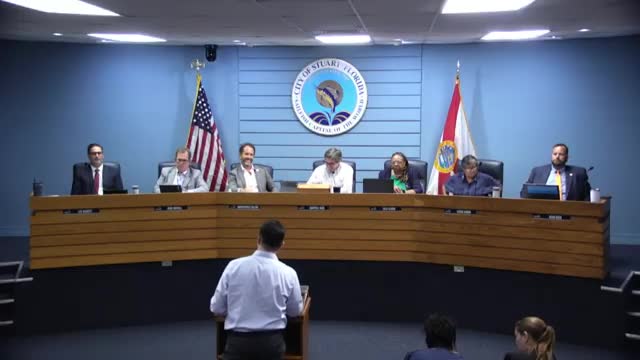
Summary
City Manager Mike Hogarth told the City of Stuart Commission on May 20 that several bills passed in the 2025 Florida Legislature will directly affect local permitting, affordable housing and post‑storm redevelopment, and he recommended city staff begin preparing to implement and respond to those changes.
City Manager Mike Hogarth told the City of Stuart Commission on May 20 that several bills passed in the 2025 Florida Legislature will directly affect local permitting, affordable housing and post‑storm redevelopment, and he recommended city staff begin preparing to implement and respond to those changes.
Hogarth said the most consequential for the city is the emergency‑development bill (Senate Bill 180), which restricts local governments’ ability to adopt new land‑development or comprehensive‑plan ordinances or issue moratoria for as long as specified in the bill following certain hurricanes and, in one section (sec. 28), imposes a retroactive restriction tied to the 2024 named storms. “Section 18 restricts local governments from adopting new ordinances related to land development or comprehensive planning and or issuing a moratorium on development for 1 year after a hurricane has made landfall,” Hogarth told the commission, summarizing the statute’s language and its scope.
Hogarth reviewed a string of other enacted measures and their local effects: an expanded Live Local workforce‑housing package (SB 1730), which freezes development density and certain zoning limits to the July 1, 2023 baseline for qualifying affordable projects and requires administrative approval processes for some demolitions and plat approvals; changes to impact‑fee procedures that increase the vote threshold required to raise fees and require phased increases; a recovery‑residence bill (SB 954) that requires reasonable‑accommodation processes consistent with federal fair‑housing law; administrative approval mandates for plats (SP 784); and a fluoride ban in public water supplies tied to SB 700, which Hogarth said becomes effective July 1.
On Live Local and the affordable‑housing reforms, Hogarth cautioned that the law places new administrative requirements and potential legal exposure on cities. He said certain processes that had been public or legislative‑level decisions are now administrative, and he flagged a requirement that local governments must permit adjacent parcels to be included in Live Local projects regardless of underlying land‑use designations. The bill also, he said, requires a needs assessment before imposing moratoria and limits moratoria duration.
Hogarth warned that the emergency‑development bill is likely to be litigated and described the legislative outcome as an “overreach” that could limit local home‑rule authority. Commissioners discussed asking the governor to veto the emergency language; several commissioners asked staff to prepare a letter to Gov. Ron DeSantis making the city’s objections known. Hogarth said staff will draft a letter for the mayor’s review; he cautioned that the governor cannot line‑item veto a text amendment and that the city’s request might not change the outcome, but he said he would place the request on the record.
Commissioners also asked staff to analyze practical steps for auditing Live Local projects that claim to reserve 40% of units as affordable, including defining utilities, unit sizing and monitoring compliance. Hogarth said staff have been preparing land‑use regulation agreement (LURA/LoRA) language to establish what must be provided and how rents and unit counts will be enforced.
No formal action was required on the briefing, but the commission gave direction to staff to draft an expedited letter to the governor expressing the commission’s concerns about the emergency‑development provisions and to begin internal work on Live Local implementation details.
Speakers quoted are from the City of Stuart meeting record and include the city manager and elected commissioners.