Get Full Government Meeting Transcripts, Videos, & Alerts Forever!
Get email alerts on the Juvenile Justice topic
No spam. Unsubscribe anytime.
Senate negotiates juvenile‑justice package amid privacy fight over probation lists and detention rules
Summary
The Nebraska Legislature debated and amended LB 530 — a committee package of juvenile‑justice measures — including new language to identify ‘comprehensive supervision’ probationers, tighter review rules for detention of young juveniles and an extended discussion about restrictions on law‑enforcement access to probation lists.
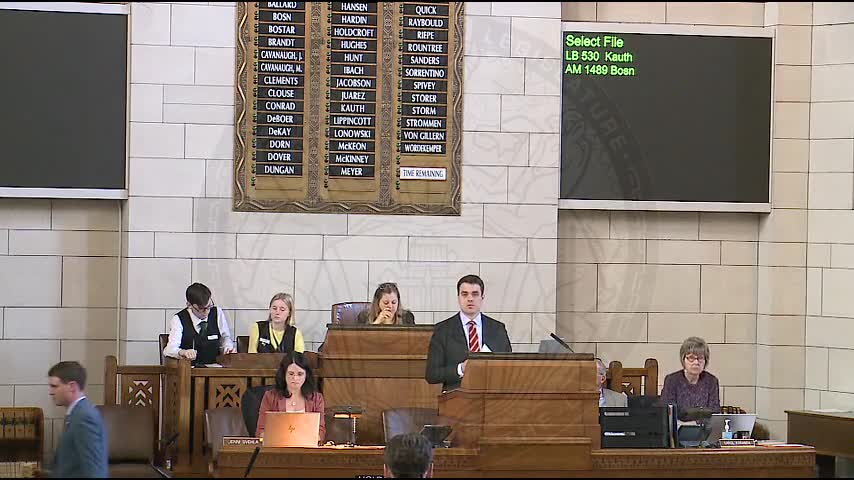
The Nebraska Legislature took up LB 530, the Judiciary Committee’s juvenile‑justice package, and adopted a committee amendment after further floor negotiation on May 22. The package bundles several bills and committee‑level compromises that change when juveniles may be detained, how higher‑need probationers are identified and how courts and human‑services agencies coordinate services.
Why it matters: LB 530 touches baseline practices for juvenile supervision, detention thresholds for younger youth, and the mechanics of information sharing among probation, courts and law enforcement — questions that affect public safety, privacy and racial‑equity outcomes in Nebraska communities.
Key changes and points from floor debate: - “Comprehensive supervision” category: The committee amendment adds a statutory category — “comprehensive supervision probationers” — for juveniles whom the court determines need intensive supports (therapeutic services, education/vocational assistance, family engagement and behavioral interventions). The court must consider adjudication history, effectiveness of prior interventions and any dual involvement with child‑welfare services when designating a juvenile for comprehensive supervision.
- Detention safeguards for younger juveniles: The amendment adds an extra layer of protection for juveniles 12 and under. Before a court may order detention for that age group it must find that temporary alternative placements have been exhausted and must provide a regular review (every five days in the draft language) and opportunity for counsel to request detention hearings to avoid unnecessary stays.
- Privacy and access to probation lists: A contentious floor debate focused on a provision requiring probation to generate monthly lists of certain juvenile probationers and provide those lists to law enforcement agencies. Senator James McKinney introduced two floor amendments proposing tighter controls on who may directly access such lists — limiting access to higher‑ranked officers (captain, deputy chief, chief, sheriff or equivalent) and requiring law enforcement to create user groups/accounts. Proponents of those amendments argued that juvenile records are sensitive, and open access can be weaponized or produce disparate enforcement in minority communities. Opponents said restricting access would hamper prompt, safe interactions by officers and would be difficult to implement across varied agency IT systems.
What senators said: Supporters of the committee package, including Chairwoman Lydia Boson and Senator Spivey, said the changes aim to identify the minority of probationers who need more intensive services while protecting the majority who are successful in typical supervision. They emphasized interagency coordination (probation, courts, Department of Health and Human Services) to prevent service gaps for dually involved youth.
Opponents and privacy advocates, including Senator McKinney and Senator Spivey in different moments, argued for tighter limits on data access and stronger protections, citing historic racial disparities in juvenile justice and examples — offered on the floor — of youth being subjected to heightened enforcement after being placed on lists. Several senators asked whether existing information systems (CJIS/NCIS) could impose the technical “user group” protections proposed; testimony from a law‑enforcement technical contact on the floor said user groups are possible in many systems.
Budget and implementation: The A bill (fiscal attachment) for LB 530 requested a modest increase in cash‑funded spending to support judicial and probation workloads stemming from the package. Supporters noted implementation costs tied to additional hearings and services for the subset of youth requiring comprehensive supervision; opponents urged careful review of unfunded mandates to counties and local jurisdictions. A proposed floor amendment to require state reimbursement for increased political‑subdivision costs failed on a roll call.
Outcome on the package: After multiple floor amendments (some adopted, some defeated), the committee amendment (AM 1489) moved forward for engrossing. A separate post‑conviction relief provision that had been included in the committee package was struck by a floor amendment (FA 276) after stakeholders raised technical concerns; sponsors said they will continue work in the interim and consider a standalone bill next session.
Context and next steps: Senators on both sides described long negotiations that included county attorneys, probation, defense counsel, law enforcement and community advocates. Several senators asked for additional interim work to refine definitions, ensure IT compatibility and address funding; supporters said they will continue stakeholder meetings. With AM 1489 advanced, LB 530 will proceed through the Legislature’s remaining steps where additional amendments or budget action could follow.
Sources: floor debate and roll calls in the Nebraska Unicameral, May 22, 2025.