Get Full Government Meeting Transcripts, Videos, & Alerts Forever!
Get email alerts on the Department Merger Perkins Canal topic
No spam. Unsubscribe anytime.
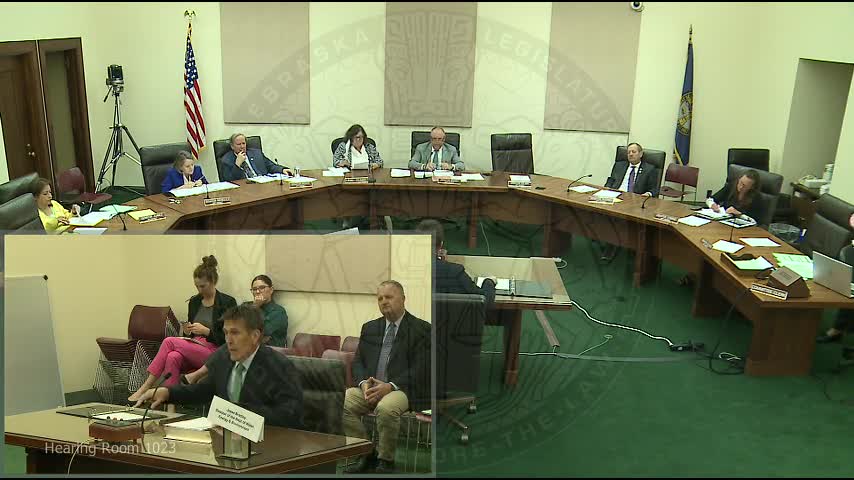
Nominees for Nebraska’s new Water, Energy and Environment agency outline canal plans and timeline
Summary
At Natural Resources Committee hearings, nominees Jesse Bradley and Matthew Manning described the new Department of Water, Energy and Environment’s priorities, including the Perkins County Canal Project, permitting steps and an expected multi-year permitting timeline and land-acquisition status.
Jesse Bradley, Governor Hillen’s nominee to lead the newly created Nebraska Department of Water, Energy and Environment, and Matthew Manning, Governor Pilling’s nominee for chief water officer, told the Legislature’s Natural Resources Committee that the department will prioritize integrated water planning, permitting coordination and stakeholder communication as it stands up the merged agency.
Bradley described the merger as a "generational opportunity" to align water, energy and environmental programs and said the department will emphasize "customers, communication, and culture." He told senators the Perkins County Canal Project is "the most critical project going on in the state" for securing interstate water rights and said the incremental cost to build a larger-capacity canal was roughly $61,000,000.
Manning, a licensed civil engineer and attorney and senior project engineer with the Department of Natural Resources, gave a permitting update for the Perkins County Canal Project: the state has worked informally with the U.S. Army Corps of Engineers for 18 to 24 months and plans to hire an independent third-party consultant to support an environmental impact statement process; the state expects the permitting process to take about two to three years from the federal agencies’ review stage.
Committee members asked about right-of-way and land-acquisition progress. Bradley said the project had secured "just under 90 acres" in Colorado and that the state had issued offers to six Colorado landowners, but that none of those offers had closed. Manning said the state was preparing an RFP through DAS to select the third-party consultant and expected responses within about a month.
Senators pressed nominees on cost, timeline and public engagement: Bradley said the additional canal capacity represents a long-term investment and that cost‑benefit analyses in project reports spread returns over a 50‑year term; Manning said permitting and production of an EIS would require multi-year federal review. Bradley also said the new department will host a water task force; he announced the first public task force meeting for June 2 in Kearney at 10 a.m. and said future meetings would be publicly noticed and follow the Open Meetings Act requirements.
Committee members raised federal funding concerns. Bradley said the department had seen some review of federal programs but that "most of the programs actually are remaining intact" and that obligated federal funds already contracted to the state remained available. Manning added the state is moving forward with clean water and drinking-water programs and that the Environmental Quality Council will receive annual plans for those programs in the coming month.
The record shows one online proponent each for Bradley and Manning and no opponents. The committee closed the public testimony on both nominees without recording a vote during this session. No formal policy changes were adopted at the hearings; nominees described implementation steps and timelines.
The nominees described internal reorganization approaches to realize savings from the merger: Bradley cited opportunities such as eliminating duplicate administrative positions (for example, overlapping HR roles) and aligning staff across funding streams to reduce long-term costs. He said some savings will come through attrition and program realignment rather than immediate layoffs.