
Lawmakers hear split views on HB200 and carbon‑capture plans as PSC and utilities update committee
Get AI-powered insights, summaries, and transcripts
Subscribe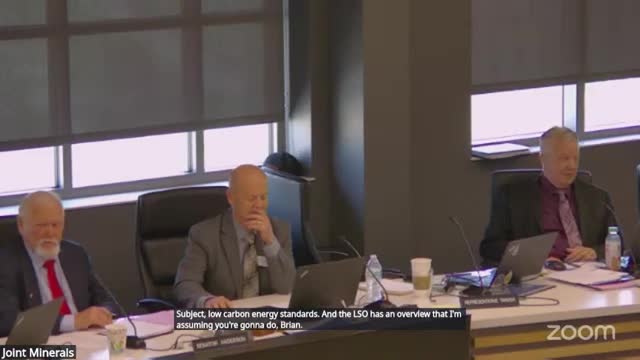
Summary
The Wyoming Public Service Commission and utilities updated the Minerals committee on implementation of the state’s low‑carbon energy statute (HB200). Rocky Mountain Power and Black Hills described FEED and pre‑FEED studies for carbon capture, estimated costs and proposed surcharges; the PSC said initial reporting is under way.
The Minerals interim committee received updates from the Wyoming Public Service Commission and from utilities on implementation of the low‑carbon energy standards established by House Bill 200 and later amendments.
Statute and reporting: LSO staff summarized the statute (Wyo. Stat. 37‑18‑101 et seq.) that directs the Public Service Commission to establish portfolio standards requiring covered utilities to develop “dispatchable and reliable low carbon electricity” from existing coal‑fired units or equivalent new coal units, and describes a rate‑recovery mechanism capped at 2% for prudently incurred incremental costs to comply. The PSC’s chief counsel told the committee the PSC filed a report in 2023 and a new biennial report to the Legislature is expected in June.
PSC and utilities: PSC Chairman Mike Robinson and counsel John Burbridge described rulemaking and filings under HB200. The PSC has adopted rules and is monitoring compliance and reliability metrics. Two Wyoming utilities are within HB200’s scope: Rocky Mountain Power (PacifiCorp) and Black Hills/Cheyenne Light, which have filed applications to establish standards and seek cost recovery as allowed under the statute.
Rocky Mountain Power: Craig Eller (RMP senior vice president, resource strategy) and Rick Cason provided details. RMP is conducting a front‑end engineering and design (FEED) study for an amine‑based carbon capture retrofit on Jim Bridger units 3 and 4; the full FEED is expected in phases with final engineering and cost accuracy improving over time (Phase 1 scope and +/-35% cost estimate due in the fall of the current year; full FEED by mid‑2027). RMP is also participating in a pre‑FEED study with SK and 8 Rivers for a novel oxy‑combustion/Allam‑cycle style unit (described as AFC/AFC pre‑FEED) at the Dave Johnston site; that partner project is funded by third parties.
Rocky Mountain Power said receipt of grants from the Wyoming Energy Authority reduced interim surcharge requests; RMP cited a matching $6.3 million grant from WEA. RMP reported collected incremental charges of about $3.9 million and incurred expenses of about $556,000 to date; its interim surcharge was reduced to about 0.12% of customer bills (12¢ per $100) effective January 1.
Black Hills / Cheyenne Light: David Bush of Black Hills said his utility filed for a 0% standard but is exploring non‑bolt‑on options including a “Bridal Loop” pre‑combustion hydrogen/CO2 project and other CO2 storage options adjacent to existing facilities. Black Hills reported earlier collection of about $883,000 and incurred expenses near $936,000; in filings they proposed a higher surcharge (the filing cited a 1.4% proposal) tied to pilot work.
Costs, technical constraints and rate implications: Committee members repeatedly asked whether HB200 is effectively imposing costs on Wyoming ratepayers now and whether the statute’s 2% recovery cap constrains future cost allocation. PSC counsel explained the statute authorizes a 2% surcharge for incremental costs but includes language addressing alternate recovery actions if the surcharge is insufficient; the PSC and utilities said large‑scale retrofit projects remain expensive (order‑of‑magnitude estimates commonly cited in testimony ranged from several hundred million to roughly $1 billion for retrofit projects) and parasitic load and reliability issues (e.g., a 35 MW parasitic load example cited for a 100 MW coal unit) present technical hurdles.
Why it matters: HB200 and its implementation will determine whether Wyoming utilities pursue carbon‑capture retrofits, how much cost is borne by in‑state customers, and whether regional allocations of generation and transmission costs change under multistate protocols. Lawmakers asked about the multi‑state allocation protocol and whether Wyoming can or should seek alternate allocations.
Ending: Committee discussion produced a legislative directive: Representative Heiner moved, and Representative Tarver seconded, a draft resolution directing the governor’s office and the Wyoming Energy Authority to pursue interstate and international cooperation on CO2 transportation and storage (compact exploring Wyoming, Montana, North Dakota and Saskatchewan). The committee voted to direct staff to draft that resolution for a future meeting.