
DEQ updates committee on mining programs, aquifer exemptions and Class VI carbon storage permitting
Get AI-powered insights, summaries, and transcripts
Subscribe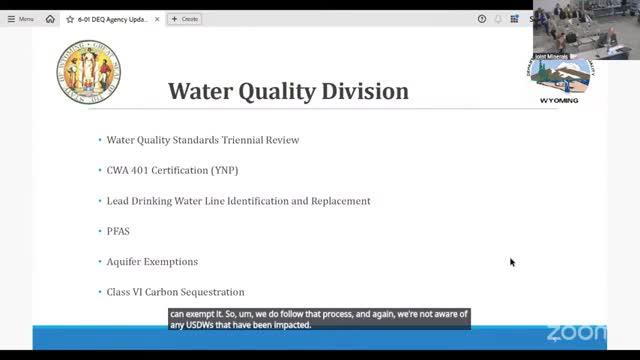
Summary
DEQ summarized land‑quality activity including program amendments pending at the Office of Surface Mining (OSM), aquifer exemptions for in situ recovery, and progress on Class VI (carbon sequestration) permits and applications.
Todd Parfitt and land quality staff told the committee that DEQ oversees coal and non‑coal programs, manages bonding for reclamation, and is pursuing several regulatory program amendments and new authorizations.
Program amendments and OSM: Parfitt said several program amendments are pending at the federal Office of Surface Mining (OSM) and that OSM staffing and leadership turnover has delayed approval. He noted that the “assigned trust” mechanism passed in state legislation requires an OSM program amendment before coal operators may use it; non‑coal mining operations (trona, bentonite, uranium) may use the mechanism in the interim.
Aquifer exemptions and uranium in‑situ recovery: Parfitt described aquifer exemptions (under the Safe Drinking Water Act framework) that allow use of certain groundwater where it does not qualify as an underground source of drinking water or where mineral production is demonstrated. He said DEQ had several aquifer exemption requests that were delayed in Region 8 but were recently approved after EPA action, which had been causing operational delays for in‑situ uranium recovery projects. He stated he is not aware of any drinking water impacts in Wyoming in the past 10 years tied to these activities.
Class VI carbon sequestration: Parfitt said Wyoming received primacy for the Class VI program (geologic CO2 sequestration) and has issued nine permits to construct, with eight additional construction permits under review and one request to inject currently in house. He said DEQ denied one early application for failing to meet requirements, and other applications are moving forward through construction permitting and subsequent injection approvals.
Source material (NRC agreement) and uranium recovery program: The department is implementing uranium recovery licensing under a regulatory agreement with the Nuclear Regulatory Commission and is pursuing a possible source‑material program addition to its agreement‑state responsibilities; DEQ said it was funded with two positions and that the program will transition to a fee model once established.
Why it matters: Pending program amendments, primacy decisions and aquifer exemptions affect the timeline for mining and reclamation activities and can influence bond obligations and closure plans; Class VI permitting shapes whether Wyoming can host geologic carbon sequestration projects.
Ending: Parfitt said DEQ will continue to work with OSM, NRC and EPA to finalize program amendments and permit reviews and that staffing and federal review timelines are the main constraints.