
DEQ says landfill remediation program making progress; lawmakers probe need for yearly bill
Get AI-powered insights, summaries, and transcripts
Subscribe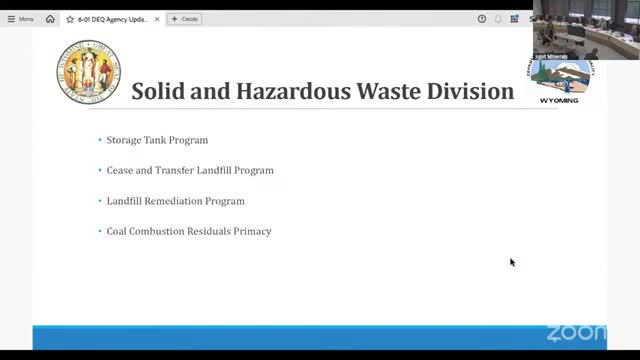
Summary
DEQ reported steps to remediate groundwater at legacy landfills, described the cease‑and‑transfer program and use of a corrective‑action account, and fielded legislative questions about whether annual legislative bills remain necessary.
Todd Parfitt told the Minerals interim committee that DEQ’s storage tank and landfill remediation programs have remediated large numbers of contaminated sites and that ongoing work is focused on prioritized sites.
Storage tanks and corrective action: Parfitt said the state’s storage‑tank cleanup program has logged 1,643 contaminated sites since 1991 and remediated 1,393, leaving approximately 250 remaining; many are in operation‑and‑maintenance mode. He said DEQ conducted about 660 inspections last year and reported a 95% compliance rate.
Cease and transfer and landfill remediation: Parfitt summarized the cease‑and‑transfer landfill program that helps small municipalities close and replace marginal local landfills, and reported 52 municipalities indicated interest; of those, DEQ has funded or completed work for 37, closed 23 landfills and funded 13 transfer facilities (and one carcass management project). He said the original legislative appropriation to kick‑start the program was $15,000,000 a year for three years.
Parfitt said the state pays roughly 75% of cleanup costs for priority landfill projects, with communities sharing some costs; DEQ covers operation and maintenance obligations (up to 10 years in his description). He said DEQ also draws from the corrective action account (funded by a roughly 1¢ per gallon fuel equivalent) to continue work without recurring appropriation requests.
Groundwater sampling numbers: Parfitt said DEQ sampled 112 landfills statewide and that about 85 showed groundwater contamination. He said early engineering estimates (circa 2012) placed the total remediation cost for 85 sites at about $226,000,000 but that later engineering work suggests DEQ will come in well under that figure for specific funded projects.
Why it matters: Small, rural communities often lack resources to remediate legacy landfills; DEQ’s program aims to provide state assistance and reduce long‑term environmental risk. Lawmakers pressed DEQ about whether annual legislative bills remain necessary to administer the program; DEQ staff and counsel said the department may already have authority in existing bill language to modify lists and report annually if the statutory bill remains in force.
Ending: The committee asked LSO and DEQ to confirm the department’s authority to continue modifying the program list without recurring statute changes; lawmakers directed staff to research and report back.