
NRC, Idaho National Laboratory tell Wyoming committee dry casks and transport rules are designed to protect public safety; permanent repository decades away
Get AI-powered insights, summaries, and transcripts
Subscribe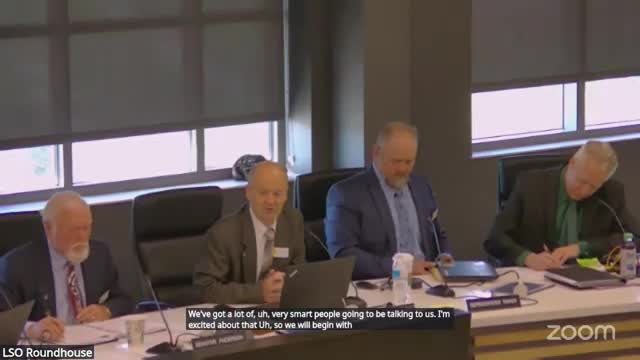
Summary
Federal and state experts told the Minerals, Business & Economic Development Committee that licensed dry-cask storage and certified transport packages meet stringent tests and inspection regimes, but a permanent national repository remains stalled and could be decades off.
Cheyenne — Federal and state experts told a Wyoming legislative committee on Thursday that licensed dry-cask storage systems and the certified transport packages used for spent nuclear fuel are designed to withstand severe accidents and protect public health while the nation lacks a permanent repository.
The committee heard a technical and legal overview from Legislative Service Office staff and multiple Nuclear Regulatory Commission (NRC) and Idaho National Laboratory (INL) experts about how spent fuel is stored, inspected and transported and about the limits of state and federal authority for permanent disposal.
NRC regional liaison Ryan Alexander told the committee, “There has never been a failure or release of radioactive material from an NRC approved transportation package or a serious injury or death from a radioactive contents of a package either during routine transportation or a transportation accident.” He summarized the federal rule set and said Type B packages and certified dry-cask designs must survive sequential crash, puncture, fire (800°C), and immersion tests.
Brian Fuller of the Legislative Service Office opened the briefing with a review of federal and Wyoming law, noting the Atomic Energy Act and the Nuclear Waste Policy Act as the primary federal authorities. Fuller highlighted a Wyoming statutory path that would require the Department of Environmental Quality and the Legislature to make four specific findings before approving the siting of an off‑site radioactive storage facility, and he described an initial applicant filing fee that is indexed to inflation.
Idaho National Laboratory nuclear engineer Daniel Thomas described four decades of U.S. experience with dry-cask storage and long-term monitoring. “We have had 0 release of radioactive material to the environment and related to that or contamination to the environment,” Thomas said, and he detailed common storage configurations (vertical, horizontal, below- or above-grade), aging management work, and inspection practice.
Committee members pressed NRC and INL staff on practical details. Representative Lisa Campbell asked whether new mobile microreactor designs and their fuel forms had been tested for transport and accident scenarios; Alexander said Radiant and other vendors are in early engagement with NRC but that specific applications must be reviewed case by case. Representative Cindy Knapp asked about inspection cadence; Alexander said regional NRC inspectors visit ISFSI (independent spent fuel storage installation) sites at least annually and inspect loading and monitoring programs and security.
Officials described the regulatory and review process in three parts: pre-application engagement, a detailed licensing review (safety and environmental analyses, often under 10 CFR Part 72 and NEPA rules at 10 CFR Part 51), and ongoing oversight including inspections of manufacturers and site operations. Fuller and Alexander repeated that NRC-issued certificates of compliance and certificates for cask designs are granted for up to 40 years and may be renewed if aging-management plans are adequate.
On the question of a geologic repository, Alexander and INL staff said the U.S. has no operational permanent repository. Alexander noted the NRC completed much of its technical review of Yucca Mountain but the Department of Energy has suspended the application process; INL’s Thomas estimated that — even under optimistic assumptions and with a statutory change — an operating repository to receive the nation’s inventory would be multiple decades away.
The committee asked the NRC for follow‑up details the agency did not have on hand: specific Yucca Mountain capacity figures and the time required to resume licensing and construction, and more complete answers about other countries’ repository timelines. Alexander said the NRC would provide additional follow-ups by letter.
Less urgent committee questions covered routine matters such as the number of loaded dry casks nationwide (Alexander cited about 4,300 loaded casks representing roughly 188,000 fuel assemblies), the role of state agencies in transport oversight (NRC and state agreement programs share inspection and regulatory duties for some materials), and the security classification that prevents public disclosure of detailed shipment plans.
The committee recessed after the briefing and took note of INL’s offer to provide additional technical materials to lawmakers. Alexander provided two public NRC brochures on spent‑fuel storage and transportation for committee members and offered further briefings on request.
Looking ahead, the committee requested written answers and follow-ups from NRC and LSO on repository capacity and timelines and said it would consider further hearings as new licensing applications or federal policy changes emerge.