
Wyoming DEQ gives lawmakers an operational update, flags bond holdings and federal budget risk
Get AI-powered insights, summaries, and transcripts
Subscribe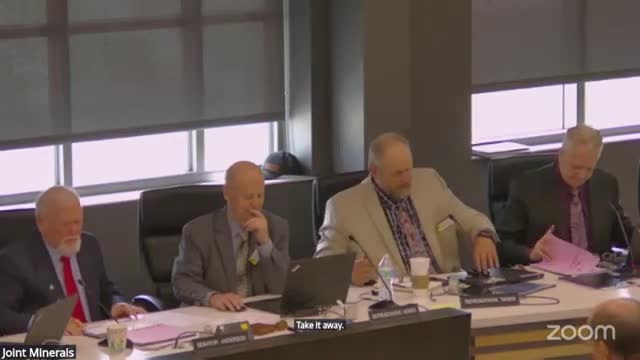
Summary
Department of Environmental Quality Director Todd Parfitt briefed the Minerals, Business & Economic Development interim committee on DEQ structure, staffing, budgets and bonding, and warned the committee of possible impacts if proposed federal cuts to EPA funding proceed.
Todd Parfitt, director of the Wyoming Department of Environmental Quality, told the Minerals, Business & Economic Development interim committee that DEQ employs about 275 full‑time staff across seven divisions and five offices, with headquarters in Cheyenne. He said the agency’s biennial operating budget is presented as roughly $203,000,000, of which the Abandoned Mine Lands (AML) program represents about $104,000,000 and skews the departmentwide funding mix. Without AML dollars the remainder totals about $99,000,000, Parfitt said.
Parfitt said DEQ’s funding mix (excluding AML) is roughly 54% general funds, 20% federal funds and 25% fee revenue. He warned the committee that the administration’s proposed federal “skinny” budget includes about a 50% reduction to EPA funding, and DEQ is evaluating what that would mean for Wyoming programs if enacted.
Why it matters: DEQ’s budget sources and staffing determine how quickly it can process permits, monitor air and water quality, and respond to remediation needs. Parfitt said the department is watching federal proposals closely and coordinating with national organizations such as the Environmental Council of the States and the Interstate Mining Compact Commission.
Parfitt reviewed DEQ’s divisional structure: air quality; water quality; solid and hazardous waste; land quality; abandoned mine lands; industrial siting; and administration/management services. He said administration carries functions that include contracts, fiscal budgets, NEPA work and the public information officer role.
On staffing, Parfitt said DEQ has offices in Cheyenne, Casper, Sheridan, Lander and Pinedale; about 170 staff are based in Cheyenne. He described recent senior leadership changes: Alan Edwards retired and Nancy Veer was appointed deputy director; Brandy O’Brien replaced Kyle Wendland as land quality administrator. Parfitt said DEQ has actively reduced vacancies in its air quality division (down from a roughly 26% vacancy rate in 2023 to about 10% and later to about 8%) by creating a step‑system for pay based on experience, and by expanding internships and university partnerships.
Parfitt also reported DEQ’s role as a bonding holder: the agency holds about $3.2 billion in bond instruments across programs, with approximately $2.5 billion tied to land‑quality programs. He said industrial siting and other program areas also carry bonding requirements for wind, solar and certain disposal facilities.
Parfitt closed by asking the committee to consider resource requests that keep staff levels sufficient to avoid permitting backlogs and to sustain program implementation if DEQ takes on additional primacy programs.
Ending: Parfitt told the panel he would provide follow‑up on specific issues raised by lawmakers and work with the legislature on funding and statutory matters affecting DEQ operations.