
Bothell planning commissioners review transportation impact fee update; no action taken
Get AI-powered insights, summaries, and transcripts
Subscribe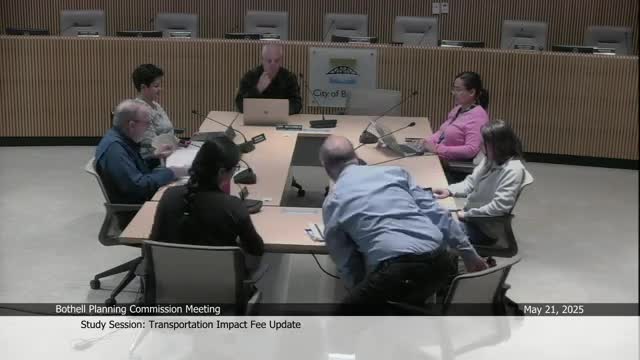
Summary
Planning commissioners spent a May 21 study session reviewing a proposed update to Bothell’s transportation impact fees aimed at shifting from a vehicle‑trip approach to a multimodal, per‑person‑trip model and asked staff and consultants for guidance on zone‑based fees and reductions for affordable housing.
Planning commissioners spent a May 21 study session reviewing a proposed update to Bothell’s transportation impact fees aimed at shifting from a vehicle‑trip approach to a multimodal, per‑person‑trip model and asked staff and consultants for guidance on zone‑based fees and reductions for affordable housing.
The discussion matters because the impact fee update will determine how much new development pays toward a $850 million (planning‑level) transportation project list in the 2024 comprehensive plan and how much the city must make up from grants or other revenue sources if fee revenue is lower than projected.
Boyd Benson, Public Works, Utilities and Development Services Manager, and consultants from Farrampier’s presented the draft approach and repeatedly emphasized that the meeting was for input only. “The goal of tonight is to present information and seek feedback about the impact fee update. There is no action being requested tonight as part of this item,” Benson said. Consultant Carmen Quan summarized the policy: “Impact fees are methods of paying for infrastructure needed to accommodate growth and meet the city's concurrency standards.”
Staff explained the mechanics: build a TIF‑eligible project list drawn from the 2024 comprehensive plan, estimate the portion of each project attributable to growth, divide the growth‑eligible project cost by projected new person trips over a 12‑year horizon and convert that to a per‑trip fee schedule by land‑use type. Staff and consultants repeatedly noted that multimodal trips (pedestrian, bicycle, transit) will be counted as “trips” for fee calculation, not only vehicle trips.
Commissioners pressed for clarity on several topics. Commissioner Jones asked why impact fees historically represent about 12% of Bothell’s transportation funding; staff explained the percentage reflects the share of the project list that can be defensibly attributed to growth and the city’s historical impact fee receipts. Staff and consultants cautioned that the 12% figure is an example coming from prior practice, not a statutory requirement.
Commissioners asked whether the city should adopt a single citywide fee or zone‑based (overlay) reductions in high‑transit or dense zones. Consultants said overlay districts (for example, downtown, regional growth centers or quarter‑mile transit areas) are a common tool: “Development in these areas, you could justify as having a lower impact on the transportation network,” Kendra Breeland said, noting any reductions must be supported by data and defensible calculations.
Affordable‑housing reductions drew considerable discussion. Staff noted Washington state law allows reduced fees for qualifying low‑income housing and child‑care developments (up to an 80% reduction for statutorily defined low‑income housing), but cautioned that broad or deep reductions shrink total fee revenue. Using illustrative numbers, staff showed that large, citywide reductions could materially reduce forecasted revenues and shift costs to other funding sources.
Commissioners queried eligibility and scope. Staff explained state law limits fee recovery to impacts related to growth in Bothell; trips that begin and end outside the city cannot be counted. Interlocal agreements with Snohomish County exist in limited areas to collect reciprocal fees for developments that straddle jurisdictional edges, but such arrangements typically produce small amounts of revenue.
Several commissioners pressed for evidence of a multimodal shift and for project sequencing that ensures investments form a connected network rather than scattered improvements. Consultants and staff said mode shift evidence is developing regionally and that the comp plan sets the policy direction; the fee update is intended to fund projects identified in the comp plan that accommodate the planned growth and multimodal network.
No motion or vote was taken. Staff will continue the impact‑fee eligibility and costing work, return to the Planning Commission with project‑level numbers and proposed fee schedules in the fall, and present the recommendation to City Council with an anticipated effective date of Jan. 1, 2026, if adopted.
Ending: Commissioners generally supported exploring zone‑based fee approaches and targeted reductions for qualifying affordable housing while asking staff to quantify revenue tradeoffs. Staff said they will bring concrete examples and calculations at the next presentation to the commission and then to council.