
MassDEP presents disposal trends and capacity limits as EPR commission begins work
Get AI-powered insights, summaries, and transcripts
Subscribe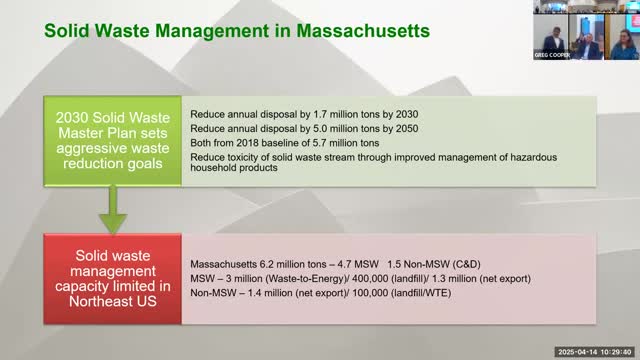
Summary
MassDEP told the EPR commission that Massachusetts disposes more trash now than in 2018, faces limited in-state capacity and rising processing costs, and has disposal-reduction targets for 2030 and 2050 that the commission's recommendations could help meet.
Massachusetts Department of Environmental Protection officials told the state's new Extended Producer Responsibility (EPR) Commission that the commonwealth faces constrained solid-waste management capacity and rising costs, and that EPR policies could help meet the state's disposal-reduction goals.
John (presenting MassDEP data) described the state's targets: a reduction of 1,700,000 tons of disposal by 2030 and 5,000,000 tons by 2050, using a 2018 baseline of about 5,700,000 tons. He told the commission that, based on 2023 data, Massachusetts disposed of about 6,200,000 tons overall, with roughly 4,720,000 tons classed as municipal solid waste and about 1,500,000 tons as construction and demolition debris.
MassDEP staff said about 3,000,000 tons of municipal solid waste are processed at in-state waste-to-energy facilities, about 400,000 tons go to in-state landfills, and on a net basis roughly 1,300,000 tons were exported to out-of-state disposal facilities. The department cautioned that Massachusetts and the broader Northeastern region have limited disposal and recycling infrastructure and that this constraint affects costs.
MassDEP presented recent cost trends reported by municipalities: from 2021 to 2024, disposal per-ton costs rose about 18 percent and recycling processing costs rose about 18 percent, while programs that manage hazardous household products reported cost increases in the range of 30 to 60 percent.
Why it matters: the commission is charged with recommending extended producer responsibility approaches for specific product categories; MassDEP framed those recommendations within broader state disposal and recycling objectives. Department staff emphasized the connection between EPR and the department's Solid Waste Master Plan.
MassDEP staff also noted that municipal recycling programs are fragmented across dozens of municipalities and that cross-border flows of waste significantly affect in-state management capacity.
The department said the commission's work should be coordinated with the ongoing Solid Waste Master Plan midterm review, which addresses toxics, market development, reuse and other topics; staff indicated the master-plan update is the appropriate venue for regulatory and programmatic items outside the commission's legislative recommendation role.
The department provided the commission with datasets and told members those materials would be shared after the meeting.