Get Full Government Meeting Transcripts, Videos, & Alerts Forever!
Get email alerts on the Community Solar topic
No spam. Unsubscribe anytime.
Lee County ZBA hears testimony on three Pivot Energy community solar projects in Nelson Township
Summary
The Lee County Zoning Board of Appeals on May 21 heard testimony and technical presentations on three special-use permit applications from Pivot Energy to build three community solar arrays and a battery-storage component in Nelson Township. The hearing was continued; no permit decisions were made.
The Lee County Zoning Board of Appeals on May 21 took testimony on three special-use permit applications from Pivot Energy to build three community solar arrays in Nelson Township, but did not decide on the permits and recessed the hearing to a later date.
Pivot Energy senior manager of project development Meryl Reed told the board the company seeks permits for three separate community solar projects — identified in filings as Pivot Energy IL 258 LLC, IL 259 LLC and IL 260 LLC — sited on agricultural land owned by Newcomer Partners. "We're the long term owner and operator of these systems," Reed said, describing project sizes, screening, and community benefits including donations and local workforce opportunities.
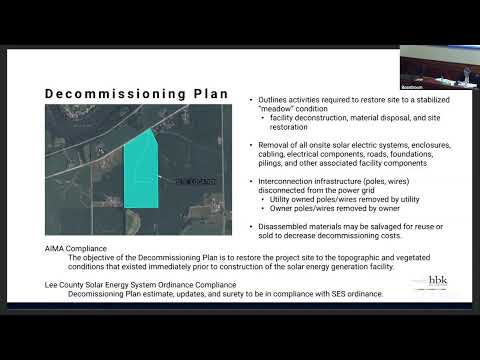
The testimony detailed technical, land-use and community impacts that the ZBA said it will review before making a recommendation to the county board. Thomas Bach, a civil engineer with HBK Engineering, gave an overview of planned stormwater analysis and a decommissioning approach and said the consultants intend to show "no negative impact" from the projects after final stormwater calculations are completed and reviewed at building-permit stage.
Why it matters: The proposals would place ground-mounted community solar arrays and ancillary equipment on two parcels in Nelson Township and include one array paired with battery storage. The projects raise typical land-use issues — setbacks, screening, drainage, construction impacts, decommissioning assurance, and equipment safety — and would affect neighboring residents and local taxing districts if permitted.
Pivot Energy and project details
Pivot’s filings list three petitions (25P1642, 25P1643, 25P1644) filed April 3, 2025, for solar arrays on agriculturally zoned land. Reed said the three arrays occupy about 17.5 acres (IL 258), 18 acres (IL 259) and 18 acres (IL 260). Proposed capacities given in testimony: IL 258 — 3.5 megawatts AC (about 7.54 GWh/year, described as roughly equivalent to powering 1,100 homes); IL 259 — 4.48 MW AC (about 10.6 GWh/year, ~1,500 homes); IL 260 — 3.75 MW AC (about 7.9 GWh/year, ~1,200 homes). Reed said IL 259 would include battery storage; IL 258 and IL 260 would be solar-only.
Reed said the company proposes 50-foot setbacks from Rock Island Road, from property lines and from residences, with the nearest home described in testimony as being about 70 feet from an array (the project plans also show a 150-foot buffer in some views). Project fencing was described as an 8-foot agricultural-style "game" fence; access would use a minimum 16-foot gravel road (the site plans show 20 feet in places). Modules named in the application were Silfab models listed at 580 watts; inverters referenced in testimony included CPS string inverters for two arrays and a Selectira device for the battery-equipped array. Batteries were described as lithium iron phosphate technology in 4–5 cabinets or a single 20–40-foot container, to sit on concrete pads.
Screening, community investments and taxes
Reed said Pivot will provide a community investment tied to system size: "We do $5,000 of donation per megawatt for each of our systems that we propose." For the three projects combined she estimated a contribution of $58,750. Reed also presented an estimate in the application that taxable property revenues would increase from about $2,500 currently to roughly $59,000 in year one and to about $725,000 over a 20-year period, tied to the projects as proposed.
Public- and technical-safety items discussed
Witnesses and board members raised issues often reviewed in solar hearings: glare, drainage and tile locates, stormwater, fencing, decommissioning, battery safety, noise and construction traffic. Reed said the applicant ran a glare analysis with Ford Solar software and reported no predicted glare to nearby residences or roadways given the proposed non-reflective panel coating and planned tree screening. Thomas Bach of HBK Engineering described the stormwater approach: the team plans to minimize the "hydrologically disturbed area" by avoiding major grading, preserving existing swales, seeding native deep-rooted vegetation beneath arrays and producing a formal stormwater report and calculations at the time of permit submission. "We will probably be looking at a reduction in peak stormwater runoff in the post developed site vegetated with the native grasses versus the current site," Bach testified.
On batteries, Reed said the batteries will have containment (either in cabinets or in containers) and that Pivot will bring a battery-storage expert to the next session for technical testimony. On electromagnetic fields, Reed said the equipment would be low-frequency and meet FCC regulations; she answered that she could not provide exact numeric EMF measures that evening and that a battery expert would also address safety questions later. On decommissioning, Bach described a plan to remove all equipment and restore the site to a stabilized meadow condition; he said decommissioning cost estimates rely on industry white papers and that relatively few projects have yet been fully decommissioned.
Resident concerns and public participation
Neighbors asked detailed questions during cross-examination and public comment. Jordan Wolford, who said her family home is about 70 feet from the project, asked about bees, grazing, odors and fencing; Reed replied the company is not proposing beekeeping on this site and that sheep grazing would be kept within fenced arrays. Board members asked about pile foundations (testimony: driven piles typically 8–12 feet), panel tilt (commonly 52 degrees, up to 60), pole set depth for on-site distribution poles (approximately 7–8 feet), and construction timing and traffic (estimated construction in fall 2026 if permitting and interconnection are finalized; construction duration 4–8 months; peak on-site workforce about 50; roughly five heavy truck deliveries per week during construction).
Process and next steps
Alice Hinkle, Lee County zoning administrator, identified notice and publication steps in the record: petitions were posted at the site (posted April 14, 2025), on the county website (April 21, 2025) and published in the Dixon Telegraph (April 12, 2025). Hinkle also confirmed receipt of application packets, exhibits and mailed notices to adjacent property owners and relevant agencies, including the Lee County health department, county engineer, township officials and the City of Dixon planning commission.
No vote or final action was taken. The hearing was recessed and rescheduled; the ZBA set a continued hearing for June 12, 2025, at 6:30 p.m., at the Lee County Courthouse, with additional dates discussed for follow-up technical testimony. The board signaled it expects additional technical reports (stormwater calculations, a noise report and a battery-storage expert) and finalized engineering exhibits, including sealed drawings, before taking a decision.
Ending
The ZBA did not grant or deny the special-use permits at the May 21 session. The board continues the evidentiary record to allow the petitioners and third-party experts to supply the stormwater calculations, a battery-storage expert report and a noise study before the next hearing. The matter will resume at the Lee County Courthouse on June 12, 2025, at 6:30 p.m., where the ZBA said it will hear further testimony and ask follow-up questions.