Get Full Government Meeting Transcripts, Videos, & Alerts Forever!
Get email alerts on the Utilities Sewer Refuse Fees topic
No spam. Unsubscribe anytime.
Sierra Vista council approves phased sewer and refuse increases, suspends development impact fees to fund plant expansion
Summary
The council approved a two-year series of sewer and residential refuse rate increases, a larger sewer connection fee, and an indefinite suspension of development impact fees; council also approved interfund transfers to cover existing negative balances and capital projects.
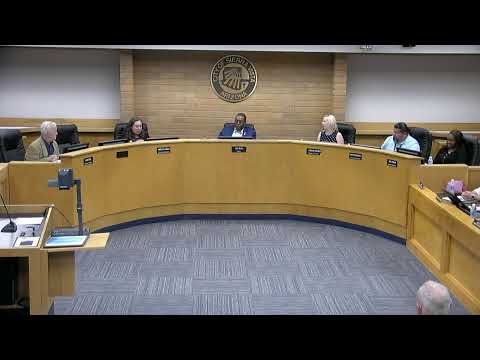
Sierra Vista — The Sierra Vista City Council on May 22 approved a package of measures to address rising sewer and refuse costs, including a phased sewer-rate increase and a suspension of development impact fees intended to help fund an upcoming sewer-plant expansion.
Councilman Mark Rodriguez moved and the council approved Resolution 2025-039, which the motion describes as a 15% sewer-rate increase and a 10% residential-refuse rate increase effective July 1, 2025, a 2.25-times increase in the sewer connection fee on that same date, and an additional 50% sewer-rate increase and another 10% residential-refuse increase effective July 1, 2026. Councilwoman Angelica Landry moved and the council approved Resolution 2025-040 to impose an indefinite suspension of development impact fees beginning July 1, 2025. The council also approved Resolution 2025-041 to transfer funds among the city’s capital and development-fee accounts.
City staff described the decisions as necessary to stabilize enterprise funds and to build capacity at the treatment plant. “The sewer enterprise funds of the city are run as businesses,” said Mr. Phillips, a city staff member, explaining that sewer and refuse operations are funded by user fees rather than sales taxes or shared state revenue. Phillips told council members that rising repair and maintenance costs, a major liner repair that cost “over half a million dollars,” and increasing vehicle and equipment costs have strained the funds.
Why it matters: staff said the plant is nearing capacity and that without increased connection fees and planned rate increases the city will not be able to expand the plant to serve future growth. According to staff, suspending development impact fees and increasing connection fees reduces the administrative burden of low projected development and, as presented to council, results in about $198 in net savings for residential builders across five fee categories.
Supporting details: staff said the liners in parts of the system have a roughly 10–15 year lifespan and that a recent liner repair exceeded $500,000. Staff also cited a recent interceptor repair connected to a commercial property (identified in the presentation as work on the Fry Boulevard Taco Bell) that cost “over $300,000” and said such repairs must be paid from the sewer enterprise fund. The staff presentation noted that development-impact-fee processes require new studies and audits and that Sierra Vista’s projected residential growth (staff cited roughly 1.5% annual growth) reduces the expected revenue from those fees.
Council action and next steps: councilors voted to approve each resolution individually. Staff said the infrastructure-development-fee balance will be transferred to a HEERF fund and to the capital improvements fund to cover planned projects including Roadrunner Park; the capital improvements fund will also make transfers to zero out negative balances in the police and fire development-fee funds that resulted from previous station construction. Council members asked clarifying questions about which types of projects each development fee could fund (for example, park development fees for regional parks and infrastructure fees limited to major arterial road lanes). Staff confirmed that the sewer connection fee is not subject to development-impact-fee rules and can be adjusted to help fund plant capacity increases.
No public comments were recorded on these items during the meeting. Staff did not present a detailed timetable for plant expansion; council approval sets the new fees to take effect July 1, 2025, and the larger rate step in July 2026.
Councilman Rodriguez and other council members emphasized the importance of keeping the plant operating to permit future growth, and staff indicated the measures were split into three resolutions to address distinct accounting and timing constraints. The council approved all three resolutions on voice vote with no opposition recorded.
Looking ahead: staff said additional engineering, budget planning and possibly grant or bond work will be required before construction. The council did not adopt a construction schedule at the meeting.