Get Full Government Meeting Transcripts, Videos, & Alerts Forever!
Get email alerts on the Lead Safe Housing topic
No spam. Unsubscribe anytime.
Lorain County, state officials urge contractors to join CHIP and Lead Safe Ohio as Feb. 28 deadline nears
Summary
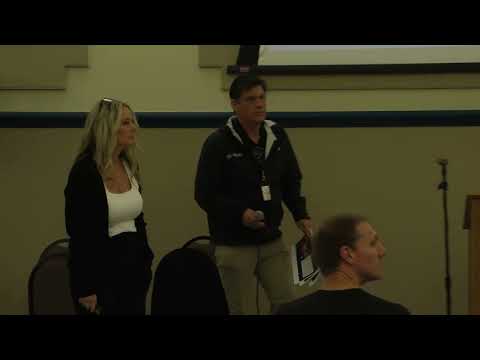
Lorain County officials and state housing staff told a packed contractor outreach forum that the county needs more contractors to bid on federally and state-funded home-repair projects and that a short execution window makes "time is of the essence," County Community and Economic Development head Dave Greenspan said.
Lorain County officials and state housing staff told a packed contractor outreach forum that the county needs more contractors to bid on federally and state-funded home-repair projects and that a short execution window makes "time is of the essence," County Community and Economic Development head Dave Greenspan said.
The outreach combined county CHIP (community housing improvement) work and Ohio's Lead Safe Ohio program. The discussion covered who may bid, required certifications, available state training and capital assistance, and county steps to reduce administrative barriers. "We are in great need of contractors," Brandy of Kleinfelder, the county's CHIP consultant, told attendees.
County and state officials said the state's Lead Safe Ohio initiative placed roughly $95 million statewide into home renovations; officials said Lorain County's share is about $1.5 million to $1.8 million (figures given by Ohio Department of Development staff during the forum). Matthew Spees of the Ohio Department of Development said the program has "a pretty short window to get that executed," and urged contractors to get certified and bid quickly.
Most immediate facts
- Who spoke: Dave Greenspan (head, Lorain County Community and Economic Development), Brandy (Kleinfelder, CHIP consultant), James Good (rehab specialist, CHIP program), Matthew Spees (Ohio Department of Development), and state lead liaisons John and Keith (Ohio Department of Development).
- Funding: speakers said about $1.5'$1.8 million remains in Lorain County for Lead Safe Ohio projects; the statewide Lead Safe Ohio appropriation was described as $95,000,000. The state also described a capital assistance grant that can reimburse qualifying contractor start-up expenses, "up to a hundred thousand dollars," for firms becoming lead-abatement contractors.
- Deadline: speakers said an extension set an execution window through Feb. 28 (extension from an earlier deadline); officials repeatedly warned contractors that the schedule is tight.
Program rules, certification and bidding process
Brandy and James Good described how CHIP projects are bid and administered: contractors receive an "invitation to bid" email and a detailed bid packet, attend a mandatory walkthrough to be eligible to bid, and sign county contracts after projects are approved by the county. "You'll get an invitation to bid," James Good said, describing the packet and walkthrough process.
State and county staff described two certification paths contractors frequently encounter:
- RRP (EPA Renovation, Repair and Painting) certification: Matthew Spees said contractors who disturb paint in pre-1978 homes must be RRP certified. The classroom-level RRP certificate requires a one-day training and a four-hour refresher every five years; the firm must also register with the EPA (Spees said the EPA firm registration fee is about $300). "Everybody needs to be RRP certified," Spees said.
- Lead abatement contractor license: abatement is a separate, more intensive licensure that requires about five days of training for the contractor of record and three days for worker-level training. Spees said the state will subsidize training when there is sufficient local demand and that lead-abatement licensure is required only when risk assessment shows abatement is necessary.
Speakers clarified subcontractor requirements: if a subcontractor's work disturbs paint in pre-1978 construction, that subcontractor must hold RRP certification; abatement licensure is required only when the specifications make a project an abatement job.
State supports and capital assistance
Spees and other state staff described two contractor-support mechanisms:
- State-funded training: Ohio Department of Development (ODOD) staff said they can arrange local RRP and lead-abatement training if enough contractors sign up. "If we find a need in Lorain County to host a class, we're happy to do it," Spees said.
- Capital assistance: the state contracts with a third party (Finance Fund) to manage a capital assistance grant for contractors becoming lead-abatement firms. Spees described the program as reimbursement-based and said eligible expenses can include worker wages during training and trucks or tools (he said analyzers are generally excluded). Contractors were told to document expenses carefully and that Finance Fund would guide applications.
Procurement, city entitlements and permitted geographies
Speakers repeated that most county-administered CHIP projects do not include properties inside the entitlement cities of Elyria and Lorain except when Lead Safe Ohio dollars specifically cover those properties. Contractors working inside those cities should contact the city housing offices for city-funded work. County staff said bid packets and invitations will clearly state scope, permit and inspection responsibilities so bidders can determine whether a project fits their capabilities.
Payment, timelines and vendor concerns
Contractors raised concerns about payment timing and short job windows. County staff acknowledged prior vendor-payment delays and described recent steps to accelerate payments, including moves toward electronic payment and an internal approval workflow. "In the last six months, there's been significant progress between the treasurer, the auditor, and the commissioners to pay vendors on a more timely fashion," Dave Greenspan said.
Speakers also said the CHIP program uses progress payments on larger rehabs so contractors do not wait until project completion for all compensation. Contractors were repeatedly urged to communicate schedule needs and delays to county staff; staff said they will work with grantees to address schedule issues when feasible.
Questions contractors raised in public comment and staff answers
- Subcontracting and specialty trades: County staff said general contractors can subcontract specialized trades (plumbing, electrical, excavation) and that subcontractors must meet RRP requirements if their work disturbs paint.
- Prevailing wage: ODOD staff said there is no statewide prevailing wage requirement for the local programs Kleinfelder administers in Lorain County, though some jurisdictions (for example, Toledo) may impose local requirements when federal funds are used.
- Asbestos: staff said CHIP does not require abatement for intact asbestos; it can be addressed in scope when present but lead remediation remains the program focus.
Next steps and contact information
County staff said they will distribute the presentation, contact lists for ODOD lead liaisons and Kleinfelder staff, and a survey to the roughly 1,000 contractors who received outreach emails. Staff asked attendees to complete the survey identifying bidding challenges so the county can streamline procurement and qualification steps. Brandy and county staff said they will help applicants who are close to qualifying meet the requirements rather than simply rejecting incomplete applications.
The forum closed with officials urging interested contractors to register for RRP training or capital assistance soon, and to watch for follow-up emails with bid invitations, training dates and contact information for Finance Fund and ODOD lead liaisons.