Get Full Government Meeting Transcripts, Videos, & Alerts Forever!
Get email alerts on the Wildfire Mitigation Funding topic
No spam. Unsubscribe anytime.
SDG&E says CPUC rate-case reduced near-term undergrounding; long-term undergrounding remains strategy
Summary
San Diego Gas & Electric told the Office of Energy Infrastructure Safety that a December 2024 CPUC general-rate-case decision reduced the money available for wildfire hardening, forcing cuts in near‑term undergrounding and other programs while the company keeps undergrounding as its preferred long‑term mitigation.
San Diego Gas & Electric told the Office of Energy Infrastructure Safety on a public presentation that a December 2024 general rate case decision reduced the company’s near-term funding for wildfire hardening, forcing SDG&E to scale back planned undergrounding and other programs.
“What was our authorized dollars for mitigation, was lower than what we asked for from the CPC decision. And so we have had to adjust our programs, namely these programs that, I wanted to highlight here, besides others is the strategic undergrounding, because of the authorized dollars is 0 miles for the next 2 years, 26 and '27, and then picking up again in 2028 with 50 miles,” SDG&E wildfire mitigation director Jonathan Waldemariam said during the presentation.
The change follows SDG&E’s earlier proposals in its Wildfire Mitigation Plan (WMP). SDG&E told regulators that it continues to regard strategic undergrounding as the most durable mitigation in many high-risk locations, but that the company must rely more on other measures while authorized mitigation spending remains constrained. SDG&E’s programs cited in the presentation include covered conductor, asset replacement integrated into undergrounding projects, advanced protection (including early-fault detection), and microgrids and communications upgrades—some of which SDG&E said will be reduced or delayed because of funding limits.
Why it matters: SDG&E said it serves about 1,500,000 electric meter accounts and that much of its overhead network and inspected inventory sit inside California’s highest fire-threat areas. The company argued undergrounding yields the greatest lifecycle risk reduction in many locations but is capital intensive.
Key program changes and targets explained in the meeting: - SDG&E described its WMP-cycle intent to install 50 miles of undergrounding and 130 miles of covered conductor for 2026–2028, but noted the CPUC-authorized dollars constrained near-term work and altered pacing. - SDG&E said the company will integrate certain asset-replacement activities into undergrounding projects rather than run separate replacement programs. - The utility said its private-LTE communications and some microgrid installs will be slowed or scoped down after 2025 because of funding limits.
SDG&E presenters framed the adjustments as a response to the regulator’s decision, not a change in long-term strategy. “We really want to go forward with trying to eliminate these risks… we believe that [undergrounding] is the best mitigation that we can put in place,” Waldemariam said, while acknowledging near-term limits.
SDG&E also said it expects to seek additional authorizations through state programs and filings. Waldemariam estimated the company would submit its SB 884 application later this year, saying the firm was “still kind of developing our scope and…and, you know, all the analysis that's required for the requirements. So, we're thinking later this year.”
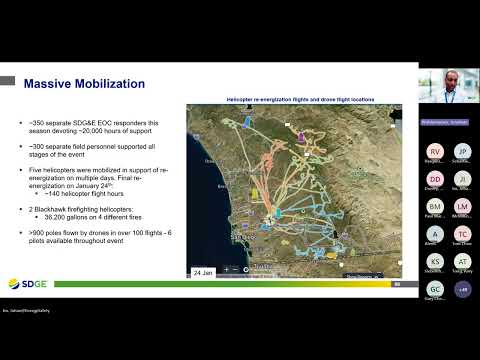
Context and constraints: SDG&E tied the funding changes to the CPUC general-rate-case outcome and to what it described as unusually severe wind and PSPS activity in December 2024–January 2025. The utility said two and a half weeks of high winds and a large PSPS activation pressed operational systems and highlighted the need for sustained mitigations.
What was not decided: The presentation outlined SDG&E’s proposed targets and described near-term reductions in activity owing to the CPUC decision; it did not include formal regulatory approvals or votes. The company said it plans to pursue additional filings and program authorization in future proceedings.
What comes next: SDG&E representatives said they would continue to refine scopes and budgets and return to regulators in subsequent filings and program applications. The utility emphasized it will continue vegetation management, inspections and other operational mitigations while pursuing longer-term undergrounding and covered-conductor rollout.