Get Full Government Meeting Transcripts, Videos, & Alerts Forever!
Get email alerts on the Fire Response Allocation topic
No spam. Unsubscribe anytime.
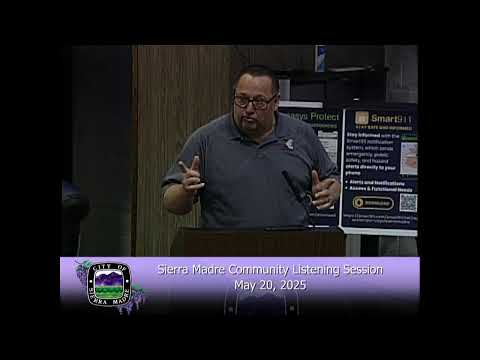
Canyon residents say they felt abandoned during Eaton Fire; city explains regional command and mutual aid
Summary
Residents from Sierra Madre’s canyon neighborhoods told city officials they felt the area was "written off" during the Eaton Fire and reported firefighting access challenges; city officials and retired firefighters explained constraints tied to single-engine staffing, narrow roads, safety and regional incident command decisions.
Multiple canyon residents told city officials during a Sierra Madre listening session that they believed emergency responders de-prioritized the canyon during the Eaton Fire, a perception some summarized as being "written off."
"During that training, someone in this room literally said, 'the canyon is a write off,'" said Janine Gillan, a resident who urged the city to clarify whether the canyon would be defended in future incidents.
Speakers described neighbors and volunteers stepping in to defend homes where larger engines could not reach. One resident credited Paul Hagen, a retired water-department worker and volunteer, and several neighbors who used hoses and sprinklers to stop embers and protect structures. Miro Sjalfre, who identified himself as a hotshot wildland firefighter and resident, read a prepared account that criticized slow deployments, inconsistent communications, and what he called insufficient coordination among responding jurisdictions.
City officials and volunteer leaders explained operational limits and how regional incident command affected local deployments. Jose Reynoso, the city manager, said Sierra Madre has a single local engine and relies on mutual aid and a regional incident command structure to task strike teams. "At one point this became a regional effort, and Sierra Madre no longer deploys," Reynoso said, adding that the city’s fire chief had a seat at the incident command post and advocated for canyon resources.
Mayor Pro Tem Christine Lowe, who is a retired fire captain, explained the operational meaning of a tactical "write off": when an area becomes too dangerous to safely operate because of limited egress and extreme conditions, crews must withdraw to preserve life. Lowe said that in some incidents, crews stage at safe locations and await larger coordinated resources such as air support or multiple engines.
Why it matters: The canyon's narrow roads and single access points complicate firefighter access and evacuation; the difference between public perception and operational decisions can affect trust and future cooperation.
Residents proposed actionable steps: improved pre-incident mapping and briefings for mutual-aid crews unfamiliar with canyon roads; identifying and maintaining secondary egress routes and hydrants (including work on the old fire road and Mount Wilson Trail); and clearer public explanation of how incident command allocates resources during a regional emergency.
City staff said some of these items can feed into the hazard mitigation plan update and the consultants' after-action recommendations. No formal changes were adopted at the session.