Get Full Government Meeting Transcripts, Videos, & Alerts Forever!
Get email alerts on the Police Budget topic
No spam. Unsubscribe anytime.
Nashville police outline staffing, school-safety and downtown policing asks as crime falls in 2025
Summary
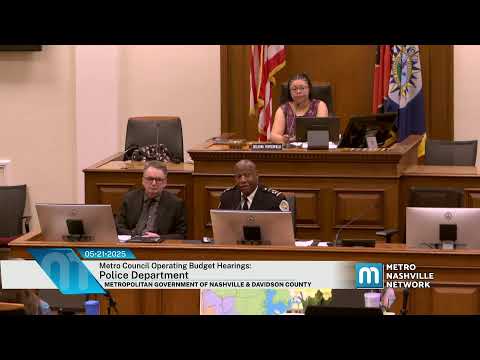
At a Metropolitan Council Budget & Finance Committee hearing, Chief Drake presented MNPD crime reductions and asked Council to consider funding requests including school-focused officers, the Alternative Police Response unit, the downtown Entertainment District Unit and vehicle retention funding.
Chief Drake, head of the Metropolitan Nashville Police Department, told the Metropolitan Council Budget & Finance Committee that major crime in Nashville is down 8.3% year-to-date and outlined the department’s staffing shortfalls and budgetary requests for the coming fiscal year.
The chief said the mayor’s proposed budget includes a $21.5 million general fund increase for the police department and that an additional $3.5 million in transit-related funding brings the total the mayor referenced to $25 million — money the department proposes to use for officers focused on school safety and precinct staffing. Janine Reed, the city finance director, confirmed the split between the general fund and transit budget during the hearing.
Why it matters: the department presented a mix of personnel, program and equipment requests that would affect school safety coverage, response times across precincts and downtown policing. Some line items — notably the Alternative Police Response unit (APR) and the Entertainment District Unit (EDU) — were not included in the mayor’s proposed budget and would require separate approval or placement on a council wish list.
Chief Drake opened with crime statistics for the first five-and-a-half months of 2025, attributing reductions to department strategies: "Overall, major crime is down 8.3%. Violent crime is down 8.5%. Property crime is down 8.2%." He said homicide is down 28% and nonlethal gunshot injuries are down 37%.
On staffing, Drake said MNPD currently has 1,572 sworn officers, a deficit of 86 from an authorized strength of 1,658. He said 39 officer trainees are in the academy, with 17 scheduled to graduate July 9 and 22 more on Oct. 7; two additional basic classes are slated to start in August and November. The chief also described a new Southeast Precinct on Murfreesboro Road that the department expects to bring online later this year; he said the precinct would cover roughly 72.7 square miles, including about 14.4 square miles of Percy Priest Lake.
The department asked the council to support several specific items:
- School-safety and precinct staffing: Drake said the mayor’s recommended general fund investment would fund 23 additional officers "to support safety in schools, including the Rapid School Safety Team" and to restore positions at precincts, especially on evening shifts. Council members and the chief clarified that the 23 officers are intended to support school-safety capacity broadly; separate state funding supports five additional SRO (school resource officer) positions cited by the chief. Councilmember Johnston noted the department’s rapid-response SRO team is not the same as adding 23 full-time SROs at individual schools.
- Alternative Police Response (APR): the APR unit — staffed primarily by part-time, retired officers who are not armed — handled 38,192 calls and completed 30,104 reports in 2024, which the chief said accounted for about 19% of all calls for service last year. Drake described the APR program as cost-saving because those staff typically do not require cars or full patrol equipment. The department requested $1.8 million to continue the APR unit; that item was not funded in the mayor’s proposed budget and Drake asked that it be placed on the council’s wish list.
- Entertainment District Unit (EDU): the department requested $4.2 million to fund a permanent unit that concentrates staffing in downtown entertainment areas Thursday through Sunday. Drake said the EDU was created to reduce officer attrition tied to rotating weekend downtown assignments; he warned that without dedicated funding the department may have to pull officers from neighborhood precincts back into downtown work, which could affect precinct staffing.
- Fleet retention and equipment: the department requested $330,000 to keep 72 high-mileage vehicles in service (for fuel and maintenance), plus funding for helicopter maintenance, body-worn camera upgrades and tracking software for 100 new police vehicles. Drake also described a recent internal shift called the "D detail" that overlaps day and evening patrols; he said since Feb. 1 those officers have responded to 2,826 calls and average response times are down nearly 10 minutes in areas served by that detail.
The hearing included questions from council members about program scope and trade-offs. Councilmember Evans asked whether APR officers are armed; Drake said they are not. Evans and others probed the trade-offs between funding the EDU and opening the Ninth Precinct: Drake said the department has been staffing downtown for years by pulling officers from precincts, and the EDU helped reduce resignations tied to mandatory downtown weekend assignments. Several council members said they worry that downtown-focused staffing can create a perception of unequal attention to neighborhoods outside the central business district.
Councilmembers also raised the department’s use of technology and surveillance. Councilmember Benedict asked about a pilot contract with a vendor (referenced as a surveillance contract) that some members said did not go through a public hearing the council’s surveillance policy would require; Drake said he would follow up. Drake said technologies such as license-plate readers and integrated camera systems could help investigators in unsolved violent cases, but acknowledged community concern and the need for guardrails.
Multiple council members asked for clearer public communication about declining crime numbers; Councilmember Soroia suggested a public outreach campaign to explain improvements and reduce fear driven by perception rather than measured crime data.
No formal council votes on these specific line items were recorded at the hearing; members questioned budget trade-offs and asked staff follow-up questions. Janine Reed of the finance office confirmed Mayor O'Connell’s split of the mayoral proposal (general fund and transit) that together make the $25 million the mayor referenced.
The committee’s next formal step is to consider the mayor’s budget recommendations in its budget process; at the hearing several council members said they would weigh the APR and EDU funding requests against other citywide priorities.
The hearing transcript did not include a formal motion or committee vote on the budget items discussed.