Get Full Government Meeting Transcripts, Videos, & Alerts Forever!
Get email alerts on the Land Use Synthetic Turf topic
No spam. Unsubscribe anytime.
Titusville planning commission approves synthetic-turf ordinance with local amendments ahead of state rules
Summary
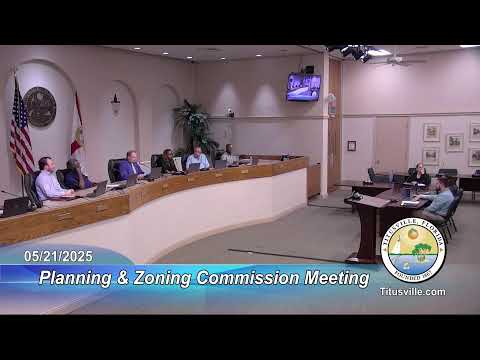
The Titusville Planning and Zoning Commission voted Thursday to approve Ordinance 21‑2025, creating local standards for synthetic turf on single‑family lots with amendments that remove a stormwater engineering requirement, alter appeals procedures and strike a concealment requirement.
The Titusville Planning and Zoning Commission voted Thursday to approve Ordinance 21‑2025, which establishes local standards for installation, performance and maintenance of synthetic (artificial) turf on single‑family lots, with amendments proposed by commissioners to remove one engineering requirement and to change the appeals pathway for deviations.
Commissioners and staff said the ordinance was written in response to a City Council referral and to increasing variance applications; it also anticipates rulemaking by the Florida Department of Environmental Protection (DEP) after passage of House Bill 683. City planning staff recommended adopting a local ordinance now so the city has clear, administrable standards until DEP issues state rules.
Tabitha, a city planner, told the commission that House Bill 683 requires DEP to adopt minimum standards for synthetic turf installed on single‑family residential lots of one acre or less and that once DEP adopts rules, local governments cannot enforce ordinances that conflict with those standards. She summarized the draft ordinance’s goals: address permeability and stormwater management, manufacturer warranties, and appropriate infill materials, and provide a clear permitting approach for common installations.
Public commenters urged two contrasting approaches. Tony Shiflow, speaking for the Historic Preservation Board, urged strict local limits and defended the city’s existing prohibition on synthetic vegetation, citing heat effects, microplastics and potential harm to the Indian River Lagoon. “The ordinance against synthetic plants is one of the soundest environmental protection laws on our books,” he said. Other speakers and several commissioners described cases where residents had sought variances for side‑ or rear‑yard turf, and some commissioners said the draft ordinance responds to that pattern.
Commission discussion focused on three central issues: (1) permeability and whether turf installed over an existing impervious or compacted base should trigger a stormwater‑management permit, (2) the ordinance’s concealment/buffering language for side yards, and (3) whether deviations from the standards should be handled as variances to the Board of Adjustment and Appeals or through a conditional‑use/limited‑use permitting route. Commissioner Grama and others questioned consistency and feasibility of requiring engineered stormwater controls for individual homeowners, noting that many driveway and driveway‑paver installations do not require site‑level retention ponds.
City staff and the city engineer explained the draft’s permeability threshold (manufacturer specifications demonstrating at least 30 inches per hour per square yard) was intended to allow manufacturers’ product data to establish permeability rather than requiring per‑site permeability testing; staff also said infill materials (letter H in the draft) were intended to be organic or sand and not impervious materials such as concrete or compacted limestone.
After debate, Member Amber Garand moved to approve Ordinance 21‑2025 as presented in the packet with three changes: remove subsection D of the artificial‑turf standards (the engineering/permitting language commissioners described as requiring stormwater permits for turf over impervious surfaces), direct that departures from the ordinance’s standards be handled as conditional use permits rather than Board of Adjustment variances, and remove the sentence in the zoning code that had required turf to be “concealed from view of the adjacent right of way.” Secretary Grama seconded the motion. The commission passed the motion in a roll call vote; Member Scully voted no and made a public record objection to removing the conditionality of variance review.
Staff told the commission the ordinance will return to City Council for second reading; DEP rulemaking could later require staff to amend the local ordinance to remain consistent with state standards. The commission directed staff to forward the approved, amended ordinance to council and noted that staff will revisit the local code once DEP issues rules.
The ordinance text and the city staff report cite existing local code sections (including code section 30‑3‑21(f) and section 33‑25 in the packet) and referenced Resolution 24‑1997 (quasi‑judicial hearing procedures); staff also summarized House Bill 683 and the DEP rulemaking requirement.
Members who spoke on the record about the item included Tabitha (city planner), Secretary Grama (commissioner), Amber Garand (commissioner, mover), Member Scully (dissenting vote), Vice Chairman Childs and Chair Nathan. Public speakers included Tony Shiflow (Historic Norwood House/Historic Preservation Board).