Get Full Government Meeting Transcripts, Videos, & Alerts Forever!
Get email alerts on the Career Technical Education topic
No spam. Unsubscribe anytime.
Career-technical programs and student ELOs draw strong interest; district reports growing applications and student wins
Summary
Students presented career-technical education (CTE) projects and extended learning opportunities (ELOs); district staff reported rising CTE applications, waitlists in several programs, credential offers for top competitors, and partnership plans with Great Bay Community College.
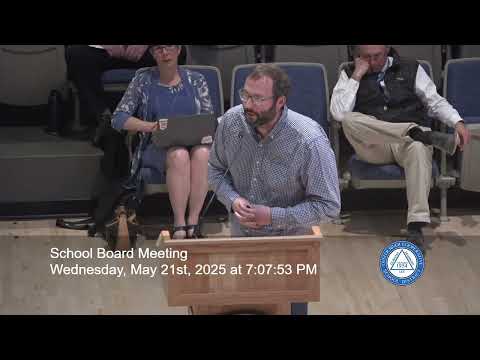
Students from the district's career-technical and extended learning programs presented projects and described internships during the May 21 meeting, while district staff reported rising demand for CTE and details on placement, credentials and partnerships.
Three students described their CTE coursework and supervised experiences. Jackie Rucker, a senior in animal science, summarized her three-year sequence that included internships at the New Hampshire SPCA and Hero Pups and awards through FFA competitions. Alison Dotchen described a high-school teaching program that included 30 internship hours in an early-learning classroom and the creation of an illustrated children's book. Dalen Jo, a junior in biomedical sciences, summarized a biofabrication-based project focused on 3D-printing and decellularization approaches to address liver cirrhosis; his class placed second in a regional BioTREC competition.
Sean Peschel, the district's CTE/ELO coordinator, provided data: 167 students applied to regional CTE programs for 2025-26; 17 withdrew, leaving 150 under review; 28 students were accepted to programs and 22 were waitlisted. The programs creating waitlists were auto technology, health science, sports medicine and criminal justice. Peschel said some students who do not get into year-two sections may be offered alternative pathways such as community-college certificate programs (for example, a welding certificate through Great Bay Community College).
District staff also highlighted competition results: Travis Fall, a senior electrical-technology student, won first place in the state SkillsUSA electrical competition and received a community-college tuition waiver and tool awards; he will represent New Hampshire at nationals.
Why it matters: District staff said CTE demand is rising and that partnerships with postsecondary providers can expand credentialing options for students who cannot access second-year seats at regional centers.
Next steps: The district will continue to build master schedules, attempt to place waitlisted students as seats open, and pursue partnerships and funding to expand CTE access and certificate pathways.