Get Full Government Meeting Transcripts, Videos, & Alerts Forever!
Get email alerts on the Land Use And Development topic
No spam. Unsubscribe anytime.
Planning commission approves Rivian service center at 60 Seventh Street with operating and fire‑safety conditions
Summary
The commission approved a conditional use permit for a Rivian vehicle service center in the city’s industrial zone, subject to noise, hazardous‑materials and fire‑safety conditions, limits on employee parking, a commuter benefit program and requirements to display transit information for employees and customers.
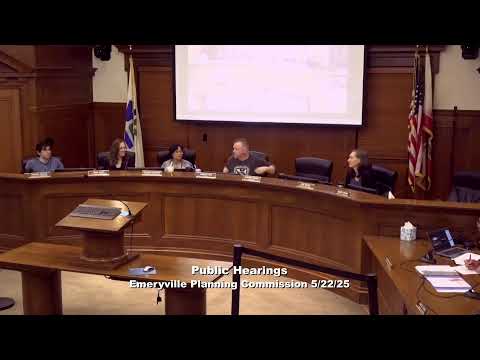
The Emeryville Planning Commission on May 22 voted to approve a conditional use permit for a Rivian service center at 60 Seventh Street in the city’s heavy industrial zone, with conditions intended to address noise, hazardous materials and firefighter safety.
The permit passed on a motion by Commissioner Martinez, seconded by Commissioner Small, with a roll‑call vote of yes from Commissioners Chafe, Gold, Martinez, Rivera, Small and Chair Wax; Vice Chair Henmey was absent.
What was proposed: Rivian plans to occupy three connected warehouses at the site and operate a service facility for Rivian electric vehicles and related sales support. Staff and the applicant said there will be no collision, paint or body work on site; services listed include software updates, tire changes, wheel alignment and battery replacements limited to units that are dead or internally faulty. Rivian estimated battery replacements would represent about 0.4% of workload (roughly 40–45 swaps per year) and said batteries would be stored on site for no more than 48–72 hours before removal.
Operating and staffing details provided to the commission show customer hours of Monday‑Friday, 8 a.m. to 6 p.m., and Saturday, 9 a.m. to 4 p.m., with two employee shifts: a daytime shift of up to 30 employees (8 a.m.–5 p.m.) and an evening/early‑morning shift of up to 15 employees (5 p.m.–2 a.m.). Rivian revised its parking plan during the review, and staff said the site would provide 58 total spaces (the parcel’s permitted maximum is 11). Staff and the applicant said many of the spaces will function as short‑term storage for vehicles waiting for service or pickup; the commission required a limit of 20 reserved employee parking spaces and one or more commuter benefit measures to encourage use of transit and alternatives.
Safety and mitigation measures: Planning staff summarized building and fire department comments and proposed conditions of approval. Staff will require Rivian to file hazardous‑materials storage and disposal plans at building permit, retain a fire protection engineer for fire‑life‑safety analysis if requested by the fire chief, and provide first‑responder training upon request. Loading hours will be limited by the city’s noise ordinance, exterior doors are to remain closed during operations, and the west‑facing overhead door must meet a minimum 45‑STC rating. Staff also recommended a condition obligating the company to post transit and alternative‑transportation information for employees and customers in visible locations.
Noise: Rivian submitted a noise study from an existing Bay Area location showing equipment noise levels from 68–96 dBA near equipment and about 63 dBA at 50 feet with doors open; Rivian and staff said there are no recorded noise complaints at their Bay Area service centers and that mitigation will include closure of exterior doors and door sound‑rating requirements.
Fire risk: Rivian and staff described battery‑handling procedures, a temporary quarantine area in the wash bay for batteries identified as at risk, and that batteries from collision‑damaged vehicles would not be received at this facility. Fire and building staff flagged typical building‑permit requirements (alarms, sprinklers, ventilation and oil/sand separators in wash bays) and staff added conditions requiring documentation of hazardous‑materials handling and demonstrations of compliance at the building‑permit stage.
Applicant comments: a Rivian representative told the commission, "we're really excited about the opportunity to take what was previously an engine world ... and turn it into a Rivian automotive service and sales center," and described proposed streetscape planting and a west‑facing mural to be reviewed at the building‑permit stage.
Outcome: The commission approved the conditional use permit with the conditions summarized above. The approval requires further design review for exterior signage and art during the building‑permit process; the permit also includes limits on certain activities (no collision/paint work) and conditions specific to electric‑vehicle battery handling and noise mitigation.
Next steps: Rivian will proceed to building permit application and must comply with fire and building department requirements prior to final occupancy.