Get Full Government Meeting Transcripts, Videos, & Alerts Forever!
Get email alerts on the Active Transportation topic
No spam. Unsubscribe anytime.
Emeryville planning commission hears first annual Active Transportation Plan progress report
Summary
Staff presented year-one outcomes from the Active Transportation Plan adopted in October 2023, including public engagement metrics, early project progress on Fortieth Street and Powell Street, program highlights such as expanded bike share and car‑free events, and a request to refine performance measures and funding detail in next year’s report.
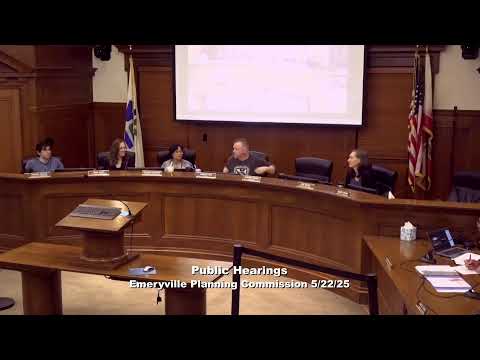
The Emeryville Planning Commission on May 22 received the city’s first annual report on the Active Transportation Plan (ATP), adopted in October 2023, detailing outreach results and early implementation steps.
The report, presented by city staff, summarized year-one achievements and next steps. "The vision is that the city of Emeryville is a community where active and sustainable transportation is the easy choice," staff said, and described early progress on safety, connectivity and outreach measures.
Why it matters: the ATP is the city’s 10‑year blueprint for pedestrian and bicycle infrastructure and programs. The annual report is intended to show what the city is implementing, provide a basis for grant applications and prompt commission feedback on measurement and priorities.
Staff told commissioners that more than 1,300 people took part in plan-related outreach during the ATP process, including 16 public meetings and multiple workshops. Noted project highlights for the first year included Fortieth Street (fully funded for construction, final design in progress), a Powell Street study (peninsula portion underway), installation of a pedestrian/bicycle counter on the Greenway, and construction work south of Powell Street. Program highlights included expanded bike‑share at Bay Street, a one‑time distribution of roughly 100 new bike racks across the city, and popular car‑free events such as “Spooky Streets” and the Harvest Festival.
Staff said policy and program recommendations are being tracked as “complete,” “in progress,” or “not yet started.” Items not yet started after year one included targeted school‑district engagement for Safe Routes to School and some evaluation/data tasks that need multi‑year data to show trends. Commissioners and public commenters asked for clearer metrics and for the report to include more detail next year on funding sources and how projects are paid for. Staff said the city uses a combination of a dedicated sustainable streets CIP account, development project requirements, and pursued grants to fund work, and agreed to add a clearer funding breakdown to next year’s report.
Commissioners asked about measurement approaches (bike counters, traffic counts, American Community Survey data and event counts) and about partnering with Alameda County public health and police data on collisions and injuries to support equity and safety tracking. Staff said the first annual report focuses on process and qualitative metrics and that more quantitative trend analysis will be possible with additional years of data.
The commission did not take formal action on the report; staff sought feedback and said the document will be shared with the Transportation Committee, BPAC and then the City Council as an informational item. Commissioners praised outreach efforts and recommended adding the ATP’s “All Ages & Abilities” map and a clearer description of funding sources and grant strategies in future reports.
Looking ahead: staff asked for commission feedback on the reporting format and said they will return next year with a report oriented to calendar‑year metrics, funding detail, and recommendations for performance indicators.