Get Full Government Meeting Transcripts, Videos, & Alerts Forever!
Get email alerts on the Museum Exhibit topic
No spam. Unsubscribe anytime.
Students open ASOM exhibit on Montagnards’ wartime role and cultural traditions
Summary
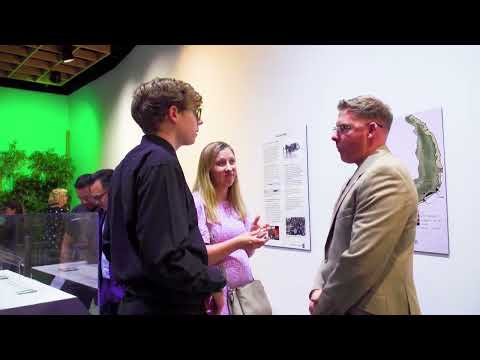
Students from Jack Brit High School opened the third annual ASOM collaborative exhibit on interactions between U.S. Special Forces and Vietnam''s Montagnard peoples, featuring artifacts from the JFK Special Worker Museum and student-written museum panels.
Student presenter 1, a Jack Brit High School student, opened the exhibit by saying, "So tonight's a big night. It's opening night here at ASOM, for the third annual, Jack Brit High School ASOM Collaborative Student Exhibit." The exhibit focuses on interactions between United States Special Forces units and the indigenous peoples of Vietnam known as the Montagnards.
Student presenter 2, a Jack Brit High School student, thanked a partnering museum: "We owe a special thank you to the JFK Special Worker Museum for their dedicated involvement, unmatched expertise, and for sharing so many artifacts that really helped bring this exhibit to life." Presenters said the artifacts are largely cultural rather than military and that the collaboration gave students practical experience in museum display and writing.
The student presenters said the project began in September and that the group's first meeting at ASOM was "early on a Saturday morning in October." Student presenter 1 described the learning curve: "the students knew very little of the, the operations of a museum, how to write, a museum level panel. A museum level panel. There's a, there's a specific type of writing that, that you need to, to be able to, to practice, where anybody, a lay person can come in off the street and read this panel." Presenters said that process — learning how to make displays visually appealing and accessible to diverse audiences — was part of the educational goal.
Several presenters described the exhibit''s historical focus and cultural materials. Student presenter 3 summarized the historical theme: "So my exhibit is the unsung heroes, the forgotten contributions of the Montagnards. It discusses the roles that the Montagnards played within the Vietnam war being in the CIDG, the Mike Force, and the Camp Defense Force." Student presenter 2 added that the exhibit addresses what happened to Montagnards who remained in Vietnam after the war, noting "the persecution. They were an ethnic minority there and the the larger Vietnamese population, discriminated against them." The presenters did not provide legal citations or government documents to support those statements; those claims are reported here as the presenters stated them.
Presenters highlighted cultural continuity. Student presenter 4 said the Montagnards and Hmong "still have their culture now, today. They still have their music, so they still pass it on to their new generations." Student presenter 5 discussed musical instruments: "They've got a lot of bamboo related, insurance. They have like a the the dangau, which is like a coconut fiddle, and then they have their own versions of their flutes, which are kinda like, pan flutes." Student presenter 5 also said that "the Montagnards are mostly in United States for their main population and in Vietnam because they still have around a million still in Vietnam." The presenters used approximate language about population size.
Student presenter 1 summarized the class''s reaction to the research and exhibit work: "We have all learned so much about this page of history that we may otherwise have never known, and we are so grateful for this opportunity. We all hope that you enjoy the exhibit as much as we've enjoyed creating it. Thank you." The exhibit opening is presented as a student-led educational showcase rather than a formal government action.