Get Full Government Meeting Transcripts, Videos, & Alerts Forever!
Get email alerts on the Groundwater Recharge Permits topic
No spam. Unsubscribe anytime.
State Water Resources Control Board staff outline temporary recharge permits and Water Code 1242.1 flood‑diversion option
Summary
Board staff at a workshop reviewed temporary groundwater‑recharge permits (180‑day and 5‑year), reporting and CEQA requirements, updated fees, the Cal Waters filing transition, and the non‑permit flood‑diversion pathway under Water Code 1242.1, stressing that none of these pathways create a water right.
State Water Resources Control Board staff at a public workshop explained how entities can use temporary permits and Water Code 1242.1 to recharge groundwater, detailed reporting and fee changes, and warned that neither pathway creates a water right.
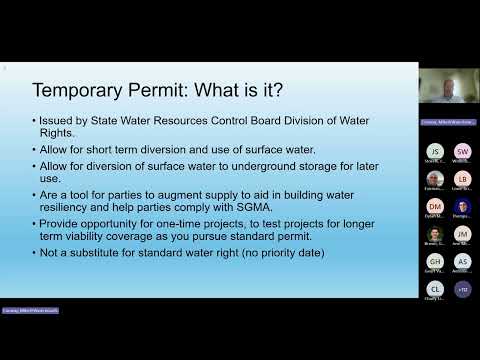
"A temporary permit is a short term authorization for either 6 months or 5 years issued by the state water board's division of water rights," said Mike Conway, who leads the recharge permitting unit. Conway told attendees the office issued six 180‑day temporary permits during the most recent diversion season, four of which used the streamlined pathway, and that applications averaged about two months to process with 30‑day public notices.
The workshop provided context for why temporary permits and the non‑permit flood diversion option are in demand: staff cited recent drought and depleted groundwater basins and noted that temporary permits do not confer priority. "Temporary permits are not water rights in that they do not provide a data priority and are last in line for flows," Conway said. Staff recommended applicants file a standard (permanent) water right application as soon as possible to secure priority while using a 5‑year temporary permit or a 180‑day permit to allow diversion during processing.
Staff described two commonly used diversion triggers under the board's streamlined pathway. The so‑called "ninetytwenty" method uses at least 30 years of gauge data to set a ninetieth‑percentile daily flow threshold or to limit diversions to 20% of daily flows; a second method uses flood‑flow thresholds coordinated with a local flood‑management entity to allow diversions when peak flows pose imminent risk to public health or safety. Conway cautioned that "novel approaches" lacking robust, modern justification or tied to unsettled actions may be difficult to process quickly and are often better suited to a standard application.
Shelby Witherby, a water resource control engineer, summarized recent changes to application fees adopted by the board. "Our up to date fees are located in the California Code of Regulations section 1062," Witherby said, and explained the fee structure now bases costs on the standard application with tiers by volume, a 25% discount for streamlined applications, incentives for advance submittal, and a 20% project complexity surcharge for proposals within the Sacramento‑San Joaquin Bay‑Delta watershed. Witherby walked through example costs the board used to show incentives for early, streamlined filings.
Erica Thompson, environmental scientist, reviewed the non‑permit option created by Water Code 1242.1 and subsequent executive orders. Thompson said 1242.1 "suspends preexisting permitting and CEQA requirements" for qualifying flood diversions and clarified that the code section "does not create a water right, water ownership, or control of surface water." She described the executive orders that informed the code and noted that Executive Order N‑16‑25 (issued Jan. 31, 2025) temporarily relaxed the requirement that local agencies rely on specific planning documents to declare imminent flood risk in designated counties.
Thompson gave the reporting schedule required under Water Code 1242.1: the person or entity diverting for recharge must submit a notice within 48 hours before or after diversion begins, a preliminary report no later than 14 days after diversion begins, and a final report no later than 15 days after diversions end. She said last season the board received three reports from two diverters totaling 499 acre‑feet diverted across 695 acres. Thompson also said all reports will be posted on the board's flood‑diversion website and that Cal Waters will replace the board's current ERIMS/Roth application portals; Roth is to close July 13 and Cal Waters to open July 14.
Staff repeatedly emphasized eligibility limits and priorities: Conway said the 5‑year temporary permit "is limited to applicants that are local public agencies," and reiterated that while 180‑day permits are technically available to individuals, the board is prioritizing applications by public agencies. In a live question, staff responded that local flood control agencies may use the 1242.1 non‑permit option when they determine an imminent flood risk, but must comply with the notice and reporting steps required by the code.
Presenters also highlighted typical permit terms and operational safeguards: most temporary permits include project descriptions, authorized diversion amounts and rates, diversion season dates, monitoring and reporting requirements, and a deputy‑director authority to stop diversions if unforeseen issues arise. Staff showed common conditions such as fish‑screen requirements and hourly diversion tracking intended to be consistent with Senate Bill 88. They advised early coordination with the California Department of Fish and Wildlife and recommended filing early to reduce the risk of fatal scope errors or process delays.
For questions or to submit reports and inquiries, staff directed attendees to flooddiversions@waterboards.ca.gov and said the workshop recording and materials will be posted online.